Showing posts with label G. Nuclear Power. Show all posts

April 18, 2014

Godzilla Makes Comeback

The high cost of fossil fuels has forced the Japanese government into a policy that entails restarting many of Japan’s nuclear plants, despite widespread public opposition. The following report from Reuters on Japan’s nuclear quandaries includes the estimate that two thirds of the country's some 50 reactors will probably stay closed, despite the government's change of course.

* * *

Japan's cabinet on Friday approved an energy policy reversing the previous government's plans to gradually mothball nuclear power plants, a move likely to be unpopular with a wary public following the 2011 Fukushima disaster.
But the plan may be too little too late for Japan's moribund atomic industry, which is floundering under the weight of estimated losses of almost $50 billion, forcing two utilities to ask the government for capital last week.
Plant operators have had to pay out almost $90 billion on replacement fossil fuels, with domestic media saying they have also spent an estimated 1.6 trillion yen ($16 billion) on nuclear plant upgrades to meet new safety guidelines.
A recent Reuters analysis shows as many as two-thirds of the country's 48 idled nuclear reactors may have to be left closed because of the high cost of further upgrades, local opposition or seismic risks.
"I think it is unavoidable that the Japanese utilities will write off most of their nuclear 'assets' and move on," said Mycle Schneider, a Paris-based independent energy consultant.
The plan defines nuclear as an "important baseload power source" meaning it can feed constant power to the grid to meet minimum requirement. But the policy document did not specify the share of nuclear in the nation's energy mix.
"Given the slim realistic prospects for a major nuclear share, the challenge will be flexibility and the whole baseload concept flies out of the window," Schneider said.
The government also named coal and hydro power as baseload sources. . . .
Japan will do as much as possible to increase renewable energy supplies, Motegi said. The government has set up a ministerial level group to study boosting such energy sources.
In the plan on Friday, Japan said it would aim to surpass renewable energy targets in past plans.
A footnote in the document said previous plans had set a target for renewable energy sources to contribute 13.5 percent of total power generation in 2020 and around 20 percent in 2030. Renewable energy sources, including hydro power, contributed around 10 percent of the country's energy by 2012.
The decision to reinstate nuclear power is likely to be unpopular and Prime Minister Shinzo Abe had to spend months convincing skeptical members of his ruling Liberal Democratic Party as well as coalition partner New Komeito, which opposes atomic energy, to accept the final draft of the plan.
The public has turned against nuclear power after watching Tokyo Electric Power Co's struggle to deal with the disaster at its Fukushima Daiichi station following a massive earthquake and tsunami in March 2011.
The crisis was the worst since the Chernobyl disaster in 1986 and all reactors in Japan have been shut for safety checks with no schedule for restarts. . . .
Recent polls put opposition to nuclear restarts at about two-to-one over support. An Asahi newspaper poll last month found that nearly 80 percent of those surveyed supported a gradual exit from atomic power. 
* * *

Japan approves energy plan reinstating nuclear power,” Reuters, April 11, 2014

January 24, 2014

Japan's Growing Fossil Fuel Burden

From Platt's Energy Economist, a tally of the sharply growing costs of Japan's fossil fuel imports, a consequence of the near-total shutdown of the nuclear industry after the accident at Fukushima in 2011. For a time in 2012, no nuclear plant was operating in Japan; since then, a few (of the some fifty reactors) have been restarted. The consequences for Japan have proven quite serious.   

It is no surprise that less than three years after Fukushima, the Japanese government is seeking to rehabilitate the nuclear industry’s role in the country’s generation mix as indicated by comments made by Trade and Industry Minister Toshimitsu Motegi in December. Returning the country’s reactors to operation would have a significant impact on the trade balance, Japan’s over-dependence on imported energy commodities, and power prices.

It is a paradox that nuclear power can be described as both cheap and expensive. The cost of new nuclear power has risen over time and new reactor construction is significantly more expensive than in the past. Combined with the high capital cost and other risks involved it is hard to make the case that it is competitive with fossil fuels. But where the capital cost was sunk decades ago and paid down or written off, the ongoing low fuel costs of nuclear mean existing nuclear fleets do provide low cost and low carbon electricity.
 
Japan is the world’s largest importer of LNG, the second biggest importer of coal and the third largest importer of oil. Having minimal production of any of these three key energy commodities, nuclear power has been essential to offsetting the security and economic implications of such a high degree of import dependency. As a result of much reduced nuclear generation, in 2012, Japan spent $289 billion on net imports of fossil fuels, more than any other country in the world, including China and the United States, according to the Institute for Energy Economics Japan. . . .
Fukushima was a disaster not just in human terms, for the nuclear industry or the finances of the Tokyo Electric Power Company, but for the country and economy as a whole. The increase in fossil fuel imports and the money paid to secure them has outweighed economic growth and gains in income. The situation has been exacerbated by depreciation of the Yen, which has made energy commodity price imports, all priced in US dollars, more expensive in local currency terms.
 Spending on net imports of fossil fuels as a ratio of nominal GDP for Japan is thought to have reached 5.3% in 2013, compared with 3.1% for China and 1.5% in the US. According to the IEEJ’s senior economist Akira Yanagisawa, China’s ratio fell because GDP grew more strongly than the increase in net fossil fuel imports, meaning no additional burden on the economy. But for Japan the opposite was the case, while currency depreciation added one percentage point to the increased burden.
 Bringing the country’s reactors back on line is proving a slow and uncertain process, owing to the new regulatory safeguards put in place in the aftermath of Fukushima. But for commodity markets, the impact will fall entirely on oil rather than LNG or coal.
 According to the IEEJ’s medium-case scenario — 16 reactors back in operation for an average of eight months in the year — oil consumption would fall from a projected 241.8 GL in fiscal 2013 to 220.4 GL in fiscal 2014, a drop of 8.6%. In contrast, natural gas use is expected to continue to rise to a record 91.1 mt in fiscal 2014, while coal consumption will increase to 191.1 mt. Even with final energy consumption falling by 0.4%, Japan’s natural gas and coal usage are expected to breach new historic highs. As such, Japan has little choice but to revert to nuclear energy.
 

* * *

Ross McCracken, “The burden that Japan is facing in its higher energy costs,” Platt’s Energy Economist, January 24, 2014. Via Barrel Blog.

March 12, 2013

Carbon Taxes, Please


Juslin Gillis of the New York Times plans a monthly column on climate change, answering charges that the Times had downgraded its environmental coverage; his first entry, “In Search of Energy Miracles,” explores the ideas of Lockheed Martin, Bill Gates, and Chinese scientists for new forms of nuclear power. Go to the piece for details on that; here I want to draw attention to his overall framework:  

Beyond the question of whether they will work, these ambitious schemes pose a larger issue: How much faith should we, as a society, put in the idea of a big technological fix to save the world from climate change?  

A lot of smart people are coming to see the energy problem as the defining challenge of the 21st century. We have to supply power and transportation to an eventual population of 10 billion people who deserve decent lives, and we have to do it while limiting the emissions that threaten our collective future. 

Yet we have already poured so much carbon dioxide, the main greenhouse gas, into the atmosphere that huge, threatening changes to the world’s climate appear to be inevitable. And instead of slowing down, emissions are speeding up as billions of once-destitute people claw their way out of poverty, powered by fossil fuels.  

Many environmentalists believe that wind and solar power can be scaled to meet the rising demand, especially if coupled with aggressive efforts to cut waste. But a lot of energy analysts have crunched the numbers and concluded that today’s renewables, important as they are, cannot get us even halfway there.  

Gillis goes on to describe and assess the various efforts to improve nuclear power, giving a not especially hopeful verdict, but offering sage counsel with regard to the parameters of energy policy and climate change:  

Two approaches to the issue — spending money on the technologies we have now, or investing in future breakthroughs — are sometimes portrayed as conflicting. In reality, that is a false dichotomy. The smartest experts say we have to pursue both tracks at once, and much more aggressively than we have been doing.  

An ambitious national climate policy, anchored by a stiff price on carbon dioxide emissions, would serve both goals at once. In the short run, it would hasten a trend of supplanting coal-burning power plants with natural gas plants, which emit less carbon dioxide. It would drive investment into current low-carbon technologies like wind and solar power that, while not efficient enough, are steadily improving.  

And it would also raise the economic rewards for developing new technologies that could disrupt and displace the ones of today. These might be new-age nuclear reactors, vastly improved solar cells, or something entirely unforeseen.  

In effect, our national policy now is to sit on our hands hoping for energy miracles, without doing much to call them forth. . . .

Amen.

March 28, 2012

Solar Flares and Nuclear Armageddon

The following essay, shocking in its conclusions, details the vulnerability of the electrical grid to extreme geomagnetic disturbances [GMD] arising from solar storms and forecasts an apocalyptic result were such an event to occur. The author, Matthew Stein, argues that “the next natural, inevitable super solar storm and resultant extreme GMD” could produce 400 Chernobyls and “would end the industrialized world as we know it, creating almost incalculable suffering, death and environmental destruction on a scale not seen since the extinction of the dinosaurs some 65 million years ago.” A year ago, senior officials of the United States, United Kingdom, and Sweden told the annual meeting of the American Association for the Advancement of Science that an intense electromagnetic storm would cause, in the worst case, two trillion dollars of damages, so Stein’s warning is rather far in excess of official estimates! He also thinks that the problem is fixable with fairly limited expenditures—some $2 billion. Alas, such preventative steps have not been taken; until they are, Stein argues, the danger is acute.

The following extract, about a third of the original, focuses on the threat posed by geomagnetic disturbances, but Stein also discusses later in his piece the potential costs of an electromagnetic pulse (EMP) attack and the measures advisable in addressing both threats:  

In the past 152 years, Earth has been struck by roughly 100 solar storms, causing significant geomagnetic disturbances (GMD), two of which were powerful enough to rank as "extreme GMDs." If an extreme GMD of such magnitude were to occur today, in all likelihood, it would initiate a chain of events leading to catastrophic failures at the vast majority of our world's nuclear reactors, similar to but over 100 times worse than, the disasters at both Chernobyl and Fukushima. When massive solar flares launch a huge mass of highly charged plasma (a coronal mass ejection, or CME) directly toward Earth, colliding with our planet's outer atmosphere and magnetosphere, the result is a significant geomagnetic disturbance.

The last extreme GMD of a magnitude that could collapse much of the US grid was in May of 1921, long before the advent of modern electronics, widespread electric power grids, and nuclear power plants. We are, mostly, blissfully unaware of this threat and unprepared for its consequences. The good news is that relatively affordable equipment and processes could be installed to protect critical components in the electric power grid and its nuclear reactors, thereby averting this "end-of-the-world-as-we-know-it" scenario. The bad news is that even though panels of scientists and engineers have studied the problem, and the bipartisan Congressional electromagnetic pulse (EMP) commission has presented a list of specific recommendations to Congress, our leaders have yet to approve and implement any significant preventative measures. . . .

If an extreme GMD were to cause widespread grid collapse (which it most certainly will), in as little as one or two hours after each nuclear reactor facility's backup generators either fail to start, or run out of fuel, the reactor cores will start to melt down. After a few days without electricity to run the cooling system pumps, the water bath covering the spent fuel rods stored in "spent-fuel ponds" will boil away, allowing the stored fuel rods to melt down and burn. Since the Nuclear Regulatory Commission (NRC) currently mandates that only one week's supply of backup generator fuel needs to be stored at each reactor site, it is likely that, after we witness the spectacular nighttime celestial light show from the next extreme GMD, we will have about one week in which to prepare ourselves for Armageddon. . . .

During the great geomagnetic storm of May 14-15, 1921, brilliant aurora displays were reported in the Northern Hemisphere as far south as Mexico and Puerto Rico, and in the Southern Hemisphere as far north as Samoa. This extreme GMD produced ground currents roughly ten times as strong as the 1989 Quebec incident. Just 62 years earlier, the great granddaddy of recorded GMDs, referred to as "the Carrington Event," raged from August 28 to September 4, 1859. This extreme GMD induced currents so powerful that telegraph lines, towers and stations caught on fire at a number of locations around the world. Best estimates are that the Carrington Event was approximately 50 percent stronger than the 1921 storm. Since we are headed into an active solar period much like the one preceding the Carrington Event, scientists are concerned that conditions could be ripe for the next extreme GMD.

Prior to the advent of the microchip and modern extra-high-voltage (EHV) transformers (key grid components that were first introduced in the late 1960s), most electrical systems were relatively robust and resistant to the effects of GMDs. Given that a simple electrostatic spark can fry a microchip and thousands of miles of power lines could act like giant antennas for capturing massive amounts of GMD-spawned electromagnetic energy, modern electrical systems are far more vulnerable than their predecessors.

The federal government recently sponsored a detailed scientific study to better understand how much critical components of our national electrical power grid might be affected by either a naturally occurring GMD or a man-made EMP. Under the auspices of the EMP Commission and the Federal Emergency Management Agency (FEMA), and reviewed in depth by the Oak Ridge National Laboratory and the National Academy of Sciences, Metatech Corporation undertook extensive modeling and analysis of the potential effects of extreme geomagnetic storms on the US electrical power grid. Based upon a storm as intense as the 1921 storm, Metatech estimated that within the United States, induced voltage and current spikes, combined with harmonic anomalies, would severely damage or destroy over 350 EHV power transformers critical to the functioning of the US grid and possibly impact well over 2000 EHV transformers worldwide.

EHV transformers are made to order and custom-designed for each installation, each weighing as much as 300 tons and costing well over $1 million. Given that there is currently a three-year waiting list for a single EHV transformer (due to recent demand from China and India, lead times grew from one to three years), and that the total global manufacturing capacity is roughly 100 EHV transformers per year when the world's manufacturing centers are functioning properly, you can begin to grasp the implications of widespread transformer losses.

The loss of thousands of EHV transformers worldwide would cause a catastrophic grid collapse across much of the industrialized world. It will take years, at best, for the industrialized world to put itself back together after such an event, especially considering the fact that most of the manufacturing centers that make this equipment will also be grappling with widespread grid failure. . . .

The Congressionally mandated EMP Commission has studied the threat of both EMP and extreme GMD events and made recommendations to the US Congress to implement protective devices and procedures to ensure the survival of the grid and other critical infrastructures in either event. John Kappenman, author of the Metatech study, estimates that it would cost about $1 billion to build special protective devices into the US grid to protect its EHV transformers from EMP or extreme GMD damage and to build stores of critical replacement parts should some of these items be damaged or destroyed. Kappenman estimates that it would cost significantly less than $1 billion to store at least a year's worth of diesel fuel for backup generators at each US nuclear facility and to store sets of critical spare parts, such as backup generators, inside EMP-hardened steel containers to be available for quick change-out in the event that any of these items were damaged by an EMP or GMD. . . .

* * *

In the comments section, Stein notes that "numerous top notch scientific experts" are in accord with his outlook:
For example, in his letter to the Nuclear Regulatory Commission on 8/5/2011, Dr. William Graham, former chief science adviser to President Reagan, and chairman of the bipartisan Congressional EMP Commission, discussed the problem of long-term widespread grid failure due to extreme geomagnetic storm, saying "A Study by the National Academy of Sciences independently confirmed the EMP Commission's assessment that, if a great geomagnetic storm like the 1859 Carrington Event recurred today, recovery of the national electric power grid would take 4 to 10 years. Such an event could also cause operators of the 108 nuclear power plants in the United States to lose the ability to perform a safe, controlled shutdown of their power reactors, producing Fukushima-like disaster on a large scale."

Matthew Stein, “400 Chernobyls: Solar Flares, Electromagnetic Pulses and Nuclear Armageddon,” truthout.org, March 24, 2012

June 4, 2011

High Costs of New Nuclear Generation

Paul Gipe argues that "it's the sheer cost of nuclear that may overwhelm any industry 'renaissance.'"
Little data exists on the actual cost of new nuclear generation. Rumors persist in Ontario, Canada, that the government's delay in building its promised new reactors was due to "sticker shock" after receiving costly proposals. Whatever the reason for delay, the actual costs of the proposals are being hidden from public view. So policy discussions are often dependent on studies of nuclear's cost by organizations with a particular axe to grind.

One exception comes from the California Energy Commission (CEC), a public agency mandated with the task of periodically examining the costs of various electricity-generation technologies that may be used in the state to meet demand. . . . [which] in its most recent Integrated Energy Policy Report examined the cost of electricity from 21 different central-station generation technologies. Such studies, says the CEC, are useful for comparing the relative costs between technologies, though the actual cost of electricity to consumers can be quite different from these hypothetical studies.

The detailed study considered three forms of ownership: merchant plant, investor-owned utility, and publicly owned utility. Merchant plants are built to serve deregulated markets and assume a high degree of market risk. They may not be able to sell all their electricity at any one time if their price is too high. Investor-owned utilities are the traditional private companies serving a regulated market. In California, Pacific Gas & Electric and Southern California Edison are investor-owned. Publicly owned utilities are municipal utilities, like SMUD. Publicly owned utilities pay fewer taxes and have access to lower cost financing than either investor-owned utilities or merchant plants.

The CEC's 186-page report, "Comparative Costs of California Central Station Electricity Generation" [PDF], found that a 1,000-megawatt pressurized water reactor would generate electricity in 2018 from as little as .17 per kilowatt-hour to as much as .34 per kilowatt-hour. These results are startling: Most renewable technologies today, even solar photovoltaics (PV), generate electricity for less than that. Only a municipal utility could generate nuclear electricity for less than the cost of solar PV.

Currently, Germany pays between .31 and .41 per kilowatt-hour for electricity from solar PV, which means that the cost of solar-generated electricity today is equivalent to the cost estimated by the CEC for a nuclear plant beginning operation in 2018. And all observers, even critics, expect the cost of solar PV to continue declining during the next decade.

In an unrelated study for the German Renewable Energy Association, consultants found that nuclear reactors are effectively uninsurable. The 157-page report [PDF] by Versicherungsforen Leipzig estimated that the premium necessary to insure a nuclear reactor from accident would cost from .20 per kilowatt-hour to a staggering $3.40 per kilowatt-hour. . . .

These studies indicate that the cost of nuclear energy is far higher than proponents have led policymakers to believe.

May 31, 2011

Drought in Northern Europe: Impacts on Food, Rivers, and Energy

From John Vidal of the UK Guardian:
One of the driest springs ever recorded in northern Europe could lead to power blackouts this summer, with nuclear reactors going offline because of low river levels. The exceptionally dry weather will also raise food prices and has already forced water restrictions on millions of people, say governments, farm groups and meteorological organisations across the continent.
Large parts of southern Britain, northern France, Germany, Switzerland, Austria and other northern and eastern European countries have had their driest three-month spells in more than 50 years, receiving just 25-60% of their long-term average rainfall since February. This has led to parched soils and difficult growing conditions for farmers, as well as to river levels that are dangerously low for wildlife. . .
Last week the European Union warned that soils were now "critically dry" in six countries. The French wheat harvest is now expected to be 11.5%-13% down on average despite an increase in the area planted this year and German output is expected to fall 7-9%. In south-east England, many farmers expect crops to fail dramatically unless steady rains come soon.
Dry weather may cut grain and oilseed yields by as much as 20%, said Allan Wilkinson, head of agriculture for HSBC Bank. "The cost of commodities is going to generally be higher, and this weather issue is going to exaggerate that," he said. Last week wheat prices rose in Chicago for two days running on the expectation that dry weather has hurt crops in France, Germany and the UK, and the UN warned that rising food prices risked riots in developing countries. On Monday, Oxfam said the average price of staple foods would more than double in the next 20 years.
France, the EU's biggest wheat producer, has made £90m available to drought-hit farmers and applied for advance financial help from the EU. More than half the country's regional departments have imposed restrictions on extracting water which has led to roads being blockaded by farmers.
Christiane Lambert, president of the largest French farm union, the Fédération Nationale des Syndicats d'Exploitants Agricoles (FNSEA), said: "The situation is deteriorating. Temperatures are rising and we are still only getting sporadic rain. The biggest problem is with cattle. There is no grass for them and the price of hay has risen dramatically. Farmers are beginning to sell their cattle to avoid paying for their food. Now the vegetable and fruit crops have come a month early which means that they coincide with harvests from Spain and north Africa so the price is very low. This is a major crisis. People are very worried. If there is no decent rain now the situation will be dramatic by the end of the summer".
"We are already in a crisis situation. It is like what we would expect in July for groundwater levels, river flows and snow melting," said French environment minister Nathalie Kosciusko-Morizet, who set up a high-level group this month to assess the damage from the driest spring on record.
In Britain, where some reservoirs are now down to 40% of their capacity and rivers in south-east England have been at historically low levels, water companies are preparing to impose hosepipe bans and other restrictions if heavy rains do not occur in the next few weeks. Across the UK, April had just 52% of the average rainfall for the month , while many areas experienced their driest springs for over 50 years.
The drought has led to some of Europe's lowest river levels recorded in more than 100 years. According to the German Federal Hydrological Agency, ships on Europe's two biggest rivers, the Rhine and Danube, are being forced to sail 50-80% empty because they are having problems navigating such low rivers. The Danube's water levels sunk to a 100- year low for the month of May in Austria. Similar problems have been reported in Germany. Car maker Ford said last week that it would cut down on using ships to transport its products, if the river levels continue to fall.
Concern is now mounting that some of Europe's nuclear reactors may be forced to temporarily close within months if there is not substantially increased rainfall. Most of France's nuclear stations rely on river water to cool them and falling rivers could force closure. EDF, which operates 58 reactors, has said it will delay maintenance work on its reactors near the Channel and Atlantic Ocean this summer to ensure electricity in case its riverside plants have to shut as they did in 2003 during a heatwave.
"EDF remains vigilant. France is undergoing an exceptional drought which has led us to reinforce surveillance in particular of its nuclear, thermal and hydropower plants", said an EDF spokesman. The situation could be made worse if Switzerland tries to maintain the water level of Lake Geneva by adjusting flows into the Rhone River, as this would reduce flows in France and affect reactors.
So far the dry conditions have not caused blackouts, but EDF has said that it lost 2.1 terawat (trillion) -hours of hydro electric power in the past three months because of low water levels. Water reservoirs for electricity production are now 54% full, 10 percentage points below the same week last year and nine points lower than in 2009. France gets about 20% of its power capacity from running water through turbines. . . .
George Combeau, Angoulême, France: "I have 100ha of maize, wheat and barley. The ground is like iron and the drought is biting hard. We have had our second-hottest April since 1900 and the driest spring since 1953 with just 15mm of rain in the past two months. Usually we would get four times that amount in just a month. Now the temperatures are increasing fast and it is very serious. The local authority imposed water restrictions on us one month ago. The maize has germinated but it is very thirsty. It can be saved if it rains for a long while, but I think the wheat crop is very badly damaged and we will be lucky to get half what we would expect. The farmers who have cattle are in a desperate situation. They cannot afford hay and they have started to sell their cattle. We are told we can expect only irregular rain. I fear it will be catastrophic".
George Dunn, Winchester, England: "I am a tenant farmer of 600 acres near Winchester, growing wheat, barley and oats and have some cattle and sheep. There's been a bit of rain recently but not nearly enough. It's too late now for many crops. Some farmers have destroyed their spring barley crop and replanted. We can expect the wheat harvest to be 10-20% down and the barley to be 30% down. It will get very serious soon for livestock farmers. They have nothing to fall back on. We're starting to see farmers selling their cattle so they don't have to feed them. The numbers of animals going to abattoirs is increasing. The price of wheat is going up but most farmers have already sold a lot of their harvest [on the future markets] in advance for a low price".

May 27, 2011

Greens for Nuclear Power

George Monbiot, of the UK Guardian, does not think the world of nuclear power, but he thinks it's a damn sight better than the available fossil fuel alternatives (coal and natural gas). Abandoning nuclear power, he argues, would place an insupportable burden on renewables. He has had a bitter row with Helen Caldicott and other anti-nuclear campaigners over the risks posed by nuclear power. He begins the piece below by defending himself against a range of misrepresentations, but then goes on the attack by identifying seven double standards that anti-nuclear campaigners have used in making their case:
Double standard one: deaths and injuries

We rightly lament the horrible consequences of industrial exposure to radiation. Two workers at Fukushima have so far received radiation burns and 17 have been exposed to levels of radiation considered unsafe. This is and should be a cause for serious concern. It is also worth remembering that no one has yet received a dose of radiation that is known to be lethal as a result of the Fukushima disaster. But if we are concerned about industrial injuries, why do we say nothing about the deaths and injuries in the industry most likely to replace nuclear power?
In China alone, the government estimates that 2,433 people died in coal-mining accidents last year. That's not injuries or exposures. It's deaths. Human rights activists believe that official figures might have been underestimated by a factor of four.

What this means is that, in the normal course of operations, at least six people are killed in Chinese coal mines every day. Even if you accept the official figure, Chinese coal mining alone kills as many people every week as the worst nuclear power accident in history – the Chernobyl explosion – has done in 25 years.

And this is to say nothing of the far larger number of injuries that coal mining inflicts, in particular the hideous lung diseases which plague so many miners and cause long, lingering and terrible deaths. When was the last time you heard an anti-nuclear campaigner drawing attention to this daily carnage?

Double standard two: the science

We emphasise, when debating climate change, the importance of the scientific consensus, and reliance on solid, peer-reviewed studies. But as soon as we start discussing the dangers of low-level radiation, we abandon that and endorse the pseudo-scientific gibberish of a motley collection of cranks and quacks, who appear to have begun with the assumption that it must be killing thousands of people every year, and retrofitted the evidence to match it.

Such people exist in every field, especially those that are politically contentious. We should, by now, have learned to be wary of them. But it seems that the temptation, for people hoping to make the case against nuclear power, is overwhelming.

For a good summary of the scientific consensus on the effects of exposure to both high and low levels of radiation, see the new post by Chris Goodall and Mark Lynas: two environmentalists who have kept their heads in this crisis.

Double standard three: radioactive pollution

If low-level radiation really was the problem that some environmentalists say it is, the focus of their campaign should be coal plants, not nuclear power. As Scientific American notes:
"The fly ash emitted by a power plant – a by-product from burning coal for electricity – carries into the surrounding environment 100 times more radiation than a nuclear power plant producing the same amount of energy."
This is because coal contains trace amounts of uranium and thorium, which are concentrated in the ash. Not only does this expose people living around coal plants to higher doses of radiation than people living around nuclear plants; but the regulations for disposing of fly ash are far weaker than the regulations for disposing of low-level nuclear waste. You may remember the controversy about RWE npower's plan to dump the fly ash from Didcot power station into a lake between the villages of Radley and Abingdon. Where were the anti-nuclear campaigners then? Can you imagine what the outcry would have been if a corporation had planned to fill it with low-level waste from a nuclear plant?

Double standard four: mining impact

Anti-nuclear campaigners emphasise the damage and pollution inflicted by uranium mines. They are right to do so. Some of these mines are hideous, and they are one of the many reasons why we should urgently develop new reactor technologies which sharply reduce the need for fresh supplies. But the impacts of coal mining are massively greater. There are hundreds of times more coal mines than uranium mines, including opencast sites, and a lot of them of them are many times bigger and more destructive than the largest uranium operations. This doesn't make uranium mining right, but it makes the likely switch to coal even more wrong.

Double standard five: costs

One of the most frequent arguments against nuclear power is that it costs too much. Many environmentalists claim that, when all the hidden costs, especially the massive decommissioning liabilities, are taken into account, electricity from atomic plants could cost as much as 5p per kilowatt hour or even more. The highest figure I have come across was the top end of the range of estimates produced by the New Economics Foundation – 8.3p. If this is correct – and I should emphasise that it's an extreme outlier – it suggests that nuclear is an extravagant means of generating low-carbon electricity.

So why do the same people support a feed-in tariff scheme under which we pay 41p per kilowatt hour for rooftop solar electricity?

Double standard six: research

Last week I argued about these issues with Caroline Lucas. She is one of my heroes, and the best thing to have happened to parliament since time immemorial. But this doesn't mean that she can't be wildly illogical when she chooses. When I raised the issue of the feed-in tariff, she pointed out that the difference between subsidising nuclear power and subsidising solar power is that nuclear is a mature technology and solar is not. In that case, I asked, would she support research into thorium reactors, which could provide a much safer and cheaper means of producing nuclear power? No, she told me, because thorium reactors are not a proven technology. Words fail me.

Double standard seven: timing

Anti-nuclear campaigners point out that it takes 10 years or so to build a new nuclear power station, and we haven't got that long, if we are serious about preventing climate breakdown. They are of course quite right: it's too little, too late. But the same problem affects every significant move to decarbonise the energy supply. By the time it has gone through the planning process, a major new grid connection to support an offshore windfarm will take roughly as long to develop as a new nuclear power station. The same goes for the pumped storage facilities required to support a largely renewable power system and for the carbon capture and storage required to reduce the impacts of fossil fuels. As for growing trees …

My point is that we have to take responsibility for every component of our energy supply and the consequences it carries; not just the section of it that's produced by nuclear reactors. And we should apply the same standards to all generating technologies. Otherwise, in the name of reducing risks to people and the planet, we will unwittingly increase them.

May 18, 2011

Rapid Atmospheric Heating Before Japan Earthquake

There were warning signs of Japan's 9.0 magnitude earthquake in the days prior to March 11, 2011, when the quake struck. From a physics blog at Technology Review comes the following:


Geologists have long puzzled over anecdotal reports of strange atmospheric phenomena in the days before big earthquakes. But good data to back up these stories has been hard to come by.
In recent years, however, various teams have set up atmospheric monitoring stations in earthquake zones and a number of satellites are capable of sending back data about the state of the upper atmosphere and the ionosphere during an earthquake.
Last year, we looked at some fascinating data from the DEMETER spacecraft showing a significant increase in ultra-low frequency radio signals before the magnitude 7 Haiti earthquake in January 2010.
Today, Dimitar Ouzounov at the NASA Goddard Space Flight Centre in Maryland and a few buddies present the data from the Great Tohoku earthquake which devastated Japan on 11 March. Their results, although preliminary, are eye-opening.
They say that before the M9 earthquake, the total electron content of the ionosphere increased dramatically over the epicentre, reaching a maximum three days before the quake struck.
At the same time, satellite observations showed a big increase in infrared emissions from above the epicentre, which peaked in the hours before the quake. In other words, the atmosphere was heating up.
These kinds of observations are consistent with an idea called the Lithosphere-Atmosphere-Ionosphere Coupling mechanism. The thinking is that in the days before an earthquake, the great stresses in a fault as it is about to give cause the releases large amounts of radon.
The radioactivity from this gas ionises the air on a large scale and this has a number of knock on effects. Since water molecules are attracted to ions in the air, ionisation triggers the large scale condensation of water.
But the process of condensation also releases heat and it is this that causes infrared emissions. "Our first results show that on March 8th a rapid increase of emitted infrared radiation was observed from the satellite data," say Ouzounov and co.
These emissions go on to effect the ionosphere and its total electron content.
It certainly makes sense that the lithosphere, atmosphere and ionosphere are coupled in a way that can be measured when one of them is perturbed. The question is to what extent the new evidence backs up this idea.
The Japan earthquake is the largest to have struck the island in modern times and will certainly turn out to be among the best studied. If good evidence of this relationship doesn't emerge from this data, other opportunities will be few and far between.
h/t Yale Environment 360

May 17, 2011

Wishful Thinking: Replacing Coal with Natural Gas


This innovative map from the Post Carbon Institute (original source here) shows the location and relative size of U.S. electrical generating capacity. Expectations that natural gas might replace coal in electricity generation are wishful thinking at best, according to the Institute. Not only are reserves of natural gas greatly exaggerated, but there are also serious limitations in infrastructure. According to a study by the Aspen Environmental Group, these include "the lack of sufficient pipeline capacity in 21 states as well as the lack of storage capacity on the East Coast, in the Central Plains states, and in Nevada, Idaho, Arizona, and Missouri." Looking at the map suggests, quite strikingly, that a vast area stretching from Illinois and Missouri in the west to Pennsylvania to Georgia in the east is entirely dominated by coal and nuclear.

May 9, 2011

Nuclear Power Better than Alternatives?

Ted Nordhaus and Michael Schellenberger of The Breakthrough Institute insist that the real alternative to nuclear power is not renewables but fossil fuels, and write caustically that most environmentalists are their own worst enemy:
Fukushima showed that, for most environmentalists, nuclear’s low-probability risks trump both the existential threat of climate change and 2m deaths annually from air pollution. Green campaigners have, ironically, fallen prey to the same misperception of risk they all too often see in a public indifferent to global warming: an obsession with dramatic but infrequent threats, while ignoring those that are banal but far more deadly. 
Many greens dismiss this criticism by claiming that the choice between nuclear and fossil fuels is false. But in this, environmental hysteria about nuclear power is matched by green delusions about renewable energy. Since at least the 1970s, greens have argued that wind and solar, when combined with energy efficiency, could meet our energy needs without resort to nuclear power or fossil fuels. Faith in what is called the “soft energy path” has taken on an almost religious quality among green activists. Yet, despite decades of subsidies, solar and wind still make up a tiny percentage of energy virtually everywhere in the world. 
Anyone who thinks turning away from nuclear will lead to more renewables need only look at what has happened in Germany. After Fukushima, it shut down seven of its 17 nuclear plants. The result has been that emissions have risen as much as 10 per cent, according to Reuters, partly due to electricity imports from coal-burning nations such as the Czech Republic. 
Germany promises that more of its future electricity will come from renewables, but if it shuts down its entire nuclear fleet the replacement power will come primarily from coal and gas. Indeed, while greens have fawned over its much-vaunted solar subsidies programme, Germany has actually been on a coal building boom, bringing 11 gigawatts of coal-fired generation online – six times the electricity it gets from solar – in the past 10 years alone.
Put simply, there is no credible path to stabilising, much less reducing, global carbon emissions without more nuclear power. We are a planet of 6bn people, heading toward 9bn. Even with better energy efficiency, global energy demand will soon double, perhaps triple. Without nuclear power, the vast majority of that demand will be met by fossil energy.
While effective coal usage has gone up in Germany since the nuclear shut down, in the long term Prime Minister Angela Merkel's government is deeply committed to a transition from nuclear and coal to renewables--not just that "more of its energy will come from renewables." This makes Germany the great laboratory for a rapid transition to renewables. From Yale Environment 360:
In mid-March, Merkel stunned the German public and other governments by announcing an accelerated phasing out of all 17 German nuclear reactors as an immediate reaction to the Fukushima disaster in Japan. The chancellor now says she wants to slash the use of coal, speed up approvals for renewable energy investments, and reduce CO2 emissions drastically. That means that the 81 million Germans living between the North Sea and the Alps are supposed to cover their huge energy needs from wind, solar, geothermal, and biomass within a few decades. Indeed, by 2030 green electricity could be the dominant source of power for German factories and households.

“We want to end the use of nuclear energy and reach the age of renewable energy as fast as possible,” Merkel said. . . . 
Merkel’s administration plans to shut down the nuclear reactors — which in recent years reliably provided up to a quarter of Germany’s huge needs as baseload electricity — by 2022 at the latest. It wants to double the share of renewable energy to 35 percent of consumption in 2020, 50 percent in 2030, 65 percent in 2040, and more than 80 percent in 2050. At the same time, the chancellor vows to cut CO2 emissions (compared to 1990 levels) by 40 percent in 2020, by 55 percent in 2030, and by more than 80 percent in 2050.

That makes Germany the world’s most important laboratory of “green growth.” No other country belonging to the G20 club of economic powers has a comparable agenda. . . . 
"It’s over,” she told one of her advisers immediately after watching on TV as the roof of a Fukushima reactor blew off. “Fukushima has forever changed the way we define risk in Germany.”

Merkel’s conservative environment minister, Norbert Röttgen, recently echoed this line of thinking when he said that the Fukushima disaster “has swapped a mathematical definition of nuclear energy’s residual risk with a terrible real-life experience.” He added: “We can no longer put forward the argument of a tiny risk of ten to the power of minus seven, as we have seen that it can get real in a high-tech society like Japan.”

The new course is a huge challenge in terms of cost and feasibility. Of the current 82 gigawatts of peak demand, about half comes from coal, 23 percent from nuclear, 10 percent from natural gas, and 17 percent from renewables. That means three quarters of Germany’s electricity sources will have to be replaced by green technology within just a few decades, if the nuclear phase-out and the CO2 goals are to be accomplished. . . . 
Merkel’s big hope for her “energy turn” is offshore wind energy. After a sluggish start, several new commercial projects are under construction. On May 2, Merkel proudly pressed a button at a ceremony on the Baltic Sea coast, setting in motion 21 huge offshore wind turbines 16 kilometers away at sea. Taken together, they can provide 50,000 households with renewable energy. . . .
Japan is moving in a direction very similar to that of Germany, with the government of Naoto Kan announcing that Japan would give up its plans to build more nuclear power plants. The decision, writes the New York Times,
will mean the abandonment of a plan that the Kan government released last year to build 14 nuclear reactors by 2030 and increase the share of nuclear power in Japan’s electricity supply to 50 percent. Japan currently has 54 reactors that before the earthquake produced 30 percent of its electricity. . . . 
The announcement Tuesday came just days after Mr. Kan said Japan remained committed to nuclear power. His apparent pull-back may be driven partly by public opinion, which has significantly soured on nuclear power since the Fukushima accident.  
Even before the announcement, the disaster had damped the nuclear industry’s hopes for a worldwide revival of reactor building. With demand for electricity and concerns about global warming both growing, the industry had projected rapid expansion, but Japan’s nuclear crisis had already caused several countries to become skittish about nuclear power. . . . 
Still, several experts and nuclear industry representatives said Tuesday that they expected demand in two important markets — China and India — to remain strong even though those counties had said they would proceed more cautiously. Both nations have rapidly growing demand for electricity, and neither has nearly enough domestic fuel to meet its needs.  
Nils J. Diaz, a former chairman of the Nuclear Regulatory Commission and a consultant for companies that want to build reactors, said he did not think the prime minister’s announcement would cause “a domino effect.” And Jonathan Hinze, vice president for international operations at the Ux Consulting Company in Roswell, Ga., which tracks the market for reactors, added that Japan’s suspension of new reactor building was less damaging than it seemed because many in the industry had doubted that Japan would have the demand to justify that much construction.   
A downturn in reactor construction would hurt Japanese companies that export nuclear plant designs and components, including Toshiba, which owns Westinghouse, and Hitachi, which is in a worldwide partnership with General Electric. Companies in France and South Korea also have a big stake in reactor building.  
On Tuesday, Mr. Kan said Japan would retain nuclear and fossil fuels as energy sources, but vowed to add two new pillars to Japan’s energy policy: renewable energy and conservation. While Japan has been a global leader in energy conservation, it lags behind the United States and Europe in adopting solar and wind power, and other new energy sources.  
“We need to start from scratch,” Mr. Kan told reporters. “We need to make nuclear energy safer and do more to promote renewable energy.” 
The wording seemed to at least leave open the possibility that some new nuclear plants could be built in the future.  
On Tuesday, Japan was reminded of the human costs of the Fukushima disaster, when the first group of 92 people paid two-hour visits to their homes in Kawauchi, within the 12-mile zone around the plant that was evacuated after the nuclear crisis.  
The residents wore white antiradiation clothing and traveled in buses under tight supervision by nuclear officials. They retrieved belongings like photo albums and the tablets traditionally used in Japan to honor dead relatives in household Buddhist shrines, according to local media reports.  
The government appeared to agonize for weeks over whether to allow even brief trips. Officials were concerned about whether civilians could be kept safe from exposure to potentially high radiation doses near the plant.  
Complicating their decision was the lack of scientific knowledge on the health effects of the radiation doses now found in many of the evacuated areas. Some scientists say radiation levels even in many evacuated areas are too low to cause immediate illness, while others worry that the incidence of cancer could rise over the long term.       
Nuclear power has suffered a comparable setback in the United States, where, in addition to safety concerns, it faces competition from cheap natural gas. A very significant divide is emerging between the "advanced industrialized democracies" and developing giants like China and India over the role of nuclear power in their energy mix.

The latest FT survey (May 30, 2011) has nuclear power bent but not broken from Fukushima: while sharp cutbacks are planned in Germany, in Japan the government still remains committed to getting 30% (rather than the more ambitious 50%) of Japan's electricity from nuclear by 2030, and "most of the leading countries that have planned to build new reactors, including China, France, the UK and South Korea, have been sticking to those plans." Growth in the nuclear power industry "will be slowed but not stopped."

April 21, 2011

Nuclear Power Viable Only When Uninsured

From the Associated Press:

From the U.S. to Japan, it’s illegal to drive a car without sufficient insurance, yet governments around the world choose to run over 440 nuclear power plants with hardly any coverage whatsoever.


Japan’s Fukushima disaster, which will leave taxpayers there with a massive bill, brings to the fore one of the industry’s key weaknesses — that nuclear power is a viable source for cheap energy only if it goes uninsured.


Governments that use nuclear energy are torn between the benefit of low-cost electricity and the risk of a nuclear catastrophe, which could total trillions of dollars and even bankrupt a country. 
The bottom line is that it’s a gamble: Governments are hoping to dodge a one-off disaster while they accumulate small gains over the long-term.


The cost of a worst-case nuclear accident at a plant in Germany, for example, has been estimated to total as much as €7.6 trillion ($11 trillion), while the mandatory reactor insurance is only €2.5 billion. 
“The €2.5 billion will be just enough to buy the stamps for the letters of condolence,” said Olav Hohmeyer, an economist at the University of Flensburg who is also a member of the German government’s environmental advisory body.


The situation in the U.S., Japan, China, France and other countries is similar. 
“Around the globe, nuclear risks — be it damages to power plants or the liability risks resulting from radiation accidents — are covered by the state. The private insurance industry is barely liable,” said Torsten Jeworrek, a board member at Munich Re, one of the world’s biggest reinsurance companies. 
In Switzerland, the obligatory insurance is being raised from 1 to 1.8 billion Swiss francs ($2 billion), but a government agency estimates that a Chernobyl-style disaster might cost more than 4 trillion francs — or about eight times the country’s annual economic output.


A major nuclear accident is statistically extremely unlikely when human errors, natural disasters or terror attacks are excluded, but the world has already suffered three in just about thirty years — Three Mile Island, Chernobyl and now Fukushima.


In financial terms, nuclear incidents can be so devastating that the cost of full insurance would be so high as to make nuclear energy more expensive than fossil fuels. . . .


As Japan’s disaster at the Fukushima Dai-ichi plant unfolds in the wake of the March 11 earthquake and tsunami, it is still unclear what the final cost might be.


Operator Tepco’s shares have been battered, and analysts say Japan — which already has the highest debt level among the world’s industrialized nations — might eventually have to nationalize the company, and take on its massive liabilities.


Tepco had no disaster insurance.


The majority of Germans and the political parties have concluded that the potential damage outweighs the benefits, and the country now stands alone among industrialized nations in its determination to overcome nuclear power.


Phasing out nuclear energy — which like in the U.S. produces a quarter of the country’s electricity — was meant to happen slowly over the next 25 years. But in the wake of Fukushima the government seems determined to speed things up, possibly pulling the plug on the last reactors within a decade, gradually replacing them with renewable energies.


“No society has to bear the potentially enormous risk of a nuclear disaster,” Hohmeyer said.

April 4, 2011

After Fukushima, Difficult Choices for China

From the Carnegie Endowment
While China’s installed nuclear power plant capacity reached only 10.8 Gigawatt (GW) by the end of last year, Beijing plans to increase its capacity to 40 GW by 2020, according to the Medium- to Long-term Development Plan for Nuclear Power issued by China’s National Development and Reform Commission in 2007. Some widespread reports say the Chinese government may revise the 2020 target upward to 70 to 86 GW, while several experts in the Chinese nuclear industry claim that a 100 GW level is achievable by that time.
In the wake of Japan’s nuclear crisis, on March 16 Beijing halted approvals of new nuclear power plants pending changes to safety standards. This move signaled a shift toward caution from a country that is embarking on the world’s biggest nuclear expansion program but where public fears of nuclear contamination are growing. Such concern was best illustrated by a recent panicked nationwide buying spree of iodized salt—even though a few kilograms of iodized salt per day is necessary to prevent the possible thyroid cancer caused by ingesting a hypothetically high level of iodine emissions that do not yet exist in China. In addition, the State Council has ordered safety checks at existing plants. . . .

Considering energy demand increases due to economic growth, burgeoning air pollution, increasingly vulnerable energy security, and mounting political pressure to mitigate climate change, the Chinese government has no easy solution to meet these simultaneous challenges. Not surprisingly, decision makers are used to making difficult tradeoffs among various energy sources: coal, which is carbon-intensive and dirty; oil, which poses national security concerns and pollutes the environment; gas, which is scarce and costly to develop; large-scale hydro power, which is ecologically devastating; nuclear, which is technologically risky; and renewables, which are often not only expensive but also intermittently available.

During China’s twelfth Five Year Plan period, which covers 2011 to 2015, the government plans to slow air-quality deterioration and coal-consumption increases while reducing carbon emissions intensity by 17 percent. Without further increasing its domestic nuclear power capacity, China will have a much more difficult time meeting its vitally important environmental targets under this plan. . . .

March 20, 2011

In the Energy Box

From Thomas Homer-Dixon:
Much of the hysteria surrounding Japan’s nuclear crisis probably isn’t justified. As Britain’s chief scientific adviser, John Beddington, noted in Tokyo on Tuesday, even in the worst case of a full meltdown of multiple reactors at the Daiichi site and combustion or explosion of the spent fuel in the plant’s storage pools, contamination is very unlikely to extend beyond 30 kilometres from the site. The Chernobyl reactor had a graphite core that caught fire. The ferocious heat propelled radioactive particles into the upper atmosphere, spreading fallout across Europe. Fukushima isn’t Chernobyl.

But it’s an unmitigated disaster, all the same. And it’s hard to see how the nuclear power industry can recover. In recent years, the capital costs of nuclear plants have skyrocketed, with estimates of the final price of plants under construction in Europe and North America coming in three to four times above initial projections. The Fukushima disaster will make this problem far worse, because governments and regulators will insist on yet more bells and whistles to guard against accident, ratcheting up the price even more.

Nuclear power is now officially on life support, except, as Globe columnist Margaret Wente has noted, in giant power-hungry countries such as India and China that believe they don’t have much choice – until they have their own meltdowns.

So using Fukushima as another verbal cudgel to batter nuclear power is simply overkill. The word, instead, should mark a turning point in human history. Twenty-five years from now, Fukushima should be the label we use for the moment when humankind finally grasped the staggering severity of its common energy problem – and started investing the real resources needed to solve it.

We’re in an energy box. The walls are high and thick, and they’re closing in. The main source of the energy that drives our civilization is not viable in the long term. Eighty per cent of our energy comes from carbon-based fuels, and their emissions are wrecking our climate. But every direction we turn to get out of this box seems blocked by technological, economic or political obstacles.

Storing the emissions of carbon-based fuels underground is phenomenally expensive. We’ve already dammed most of the best hydropower sites. Renewables such as solar and wind are too intermittent and diffuse to supply more than 20 per cent to 30 per cent of our needs. Biofuels such as corn-based ethanol take nearly as much energy to make as they give back. And nuclear power scares the wits out of people and is, anyway, pricing itself out of the market.

We can’t get out of the box just by cutting back on our energy use. Yes, conservation is essential. But modern human societies are buzzing hives of technological and social complexity, and only huge inputs of high-quality energy can create and sustain this complexity. Most of us don’t want radically simpler lives, because they’d be poorer lives in countless ways. So we need energy, lots of it – and we need new carbon-free sources.

There are a number of candidate technologies. My favourite is ultra-deep geothermal power: We drill holes eight to 10 kilometres into Earth’s crust, pump down water, then bring it back to the surface – super-heated – to drive electrical turbines. Deep geothermal has problems, among other things a propensity, somewhat ironically, to cause earthquakes. But scientists and engineers can likely solve these problems much more easily than the problems facing, say, nuclear power. And in contrast to nuclear power, deep geothermal has a certain elegance: Instead of building dangerous nuclear facilities all over Earth’s surface, we drill downward to tap a little of the vast heat emitted by the best-shielded reactor on the planet, its molten core.

Deep geothermal might turn out to be a mug’s game. We won’t know until we do the research. Yet, regardless of how we get out of the box, solving our energy problem will be a defining challenge in the evolution of our species. If we don’t face this challenge aggressively and now, it will be game over for anything resembling modern civilization. Fukushima should be the moment we all get the message.

March 17, 2011

The Perfectly Safe Nuclear Reactor: Always Just Around the Corner

From Hugh Gusterson, The Bulletin of Atomic Scientists:
We have now had four grave nuclear reactor accidents: Windscale in Britain in 1957 (the one that is never mentioned), Three Mile Island in the United States in 1979, Chernobyl in the Soviet Union in 1986, and now Fukushima. Each accident was unique, and each was supposed to be impossible. Nuclear engineers have learned from each accident how to improve reactor design so as to diminish the likelihood of that particular accident repeating itself but, as Donald Rumsfeld famously reminded us, there are always "unknown unknowns," and so each accident has been succeeded by another, unwinding in a way that was not foreseen. The designers of the reactors at Fukushima did not anticipate that the tsunami generated by an earthquake would disable the backup systems that were supposed to stabilize the reactor after the earthquake.

And presumably there are other complicated technological scenarios that we have not foreseen, earthquake faults that are undetected or underestimated, and terrorists hatching plans for mayhem as yet unknown. Not to mention regulators who place too much trust in those they regulate.

Thus it is hard to resist the conclusion reached by sociologist Charles Perrow in his book Normal Accidents: Living with High-Risk Technologies: Nuclear reactors are such inherently complex, tightly coupled systems that, in rare, emergency situations, cascading interactions will unfold very rapidly in such a way that human operators will be unable to predict and master them. To this anthropologist, then, the lesson of Fukushima is not that we now know what we need to know to design the perfectly safe reactor, but that the perfectly safe reactor is always just around the corner. It is technoscientific hubris to think otherwise.

This leaves us with a choice between walking back from a technology that we decide is too dangerous or normalizing the risks of nuclear energy and accepting that an occasional Fukushima is the price we have to pay for a world with less carbon dioxide. It is wishful thinking to believe there is a third choice of nuclear energy without nuclear accidents.

It is unlikely that all countries will make the same choice here. We are probably moving toward a post-Fukushima world in which some countries will abjure nuclear energy while others expand it. Countries with other energy options, strong democratic structures, and powerful environmental movements will probably de-emphasize, and maybe eventually renounce, nuclear energy. Switzerland has already suspended plans to build new reactors, and Germany's Angela Merkel, responding to large antinuclear protests, announced plans to close seven reactors pending further evaluation of their safety and to reconsider plans to extend the lives of Germany's oldest reactors.

In the meantime, countries with weak environmental movements and weak regulatory norms seem to be proceeding as if nothing has happened. As the Fukushima nuclear disaster unfolded, Turkey announced plans to go ahead with two reactors, and we can surely expect China, Russia, and India to do the same.

And what of the United States? Will it be like Germany and Switzerland, or like Turkey and China? A good way to think through this question is to look at how the United States responded to its last meltdown -- the meltdown of its banking system in 2008. To prevent a future recurrence of this disaster, the US government should have broken up banks that were "too big to fail," restored the Glass-Steagall Act's prohibitions on the commingling of investment and depository banks, and moved aggressively to regulate credit default swaps and financial derivatives. It did none of these things because the banks did not want it to, and the banks now run the show.

Nuclear Power Under Stress

From the Financial Times:
Although it is still too soon to know how the crisis at Fukushima will end, already the harrowing scenes from the site are provoking a widespread re-examination of nuclear safety that will, at the very least, lead to significant delays in new investments, an inevitable rise in cost and probably more rapid closures of existing plants. China, the world’s biggest builder of nuclear reactors, on Wednesday froze applications for new plants pending a review of safety.
Unless the stricken reactors are brought quickly under control, the industry could enter another two-decade global freeze like the one that followed the Chernobyl disaster in 1986. The consequences would include faster long-term growth in demand for fossil fuels, particularly natural gas, leading to tighter supplies and higher prices. It would also mean a further rise in the emissions of greenhouse gases created by burning those fuels – and further undermine climate policies around the world.

The nuclear business had engineered a remarkable turnaround. Seen only 10 years ago as a sunset industry, about to be supplanted by clean-burning gas and renewable sources such as solar, it has enjoyed a wide revival in support from energy companies, politicians and even the public. With climate policies demanding reliable low-carbon electricity, many governments in developed nations came to accept the need for nuclear as part of their future energy mix. That may now have changed. . . . 
The much-discussed “nuclear renaissance” was always more of a promise than a reality in Europe and the US. Nuclear power is a deeply political business, because the scale of the risks it entails inevitably involves governments. The support offered by most western countries has often not been strong enough to secure as much private sector investment as they had hoped. Now, governments are pulling away from whatever backing for nuclear power they had offered.
Switzerland was first to respond, suspending approvals for three new reactors on Monday. Germany followed 24 hours later, with chancellor Angela Merkel temporarily making idle seven of the country’s 17 nuclear power stations amid a three-month review of the nation’s nuclear energy policy. The Japan disaster was “a turning point in the history of technology-based society”, she said.

In the UK, where plans are well advanced to build up to 11 new reactors over the next 15 years, the government has asked its chief nuclear inspector to prepare a report on the implications of the events in Japan. Chris Huhne, the energy secretary, who has an anti-nuclear past, said on Tuesday it was too early to tell whether there would be any impact on the investment climate. But investors would “make their assessment on the basis of costs and likely returns” – and those would be affected by the inspector’s report.

In the US, support for new nuclear plants was a rare point of agreement between President Barack Obama and his Republican opponents. Steven Chu, the Nobel prize-winning energy secretary who is a long-standing supporter of nuclear power, tried to reassure members of Congress on Tuesday, telling them that “the American people should have full confidence that the United States has rigorous safety regulations in place to ensure that our nuclear power is generated safely and responsibly”. But Joe Lieberman, a high-profile independent senator and nuclear proponent, called for the US to “quickly put the brakes on [new reactors] until we can absorb what has happened in Japan”.

For all those countries, public opinion could be an immovable obstacle in the path of pro-nuclear governments. It is in the large emerging economies, particularly China and India, that enthusiasm for new nuclear plants has been strongest.

India, however, faces the same constraints as other democracies. Foreign companies were already wary of the Indian market because of a law passed last year making equipment suppliers liable for potentially unlimited costs in the event of a disaster. Local resistance to plants and fears about earthquakes and terror attacks are raising the political pressure.

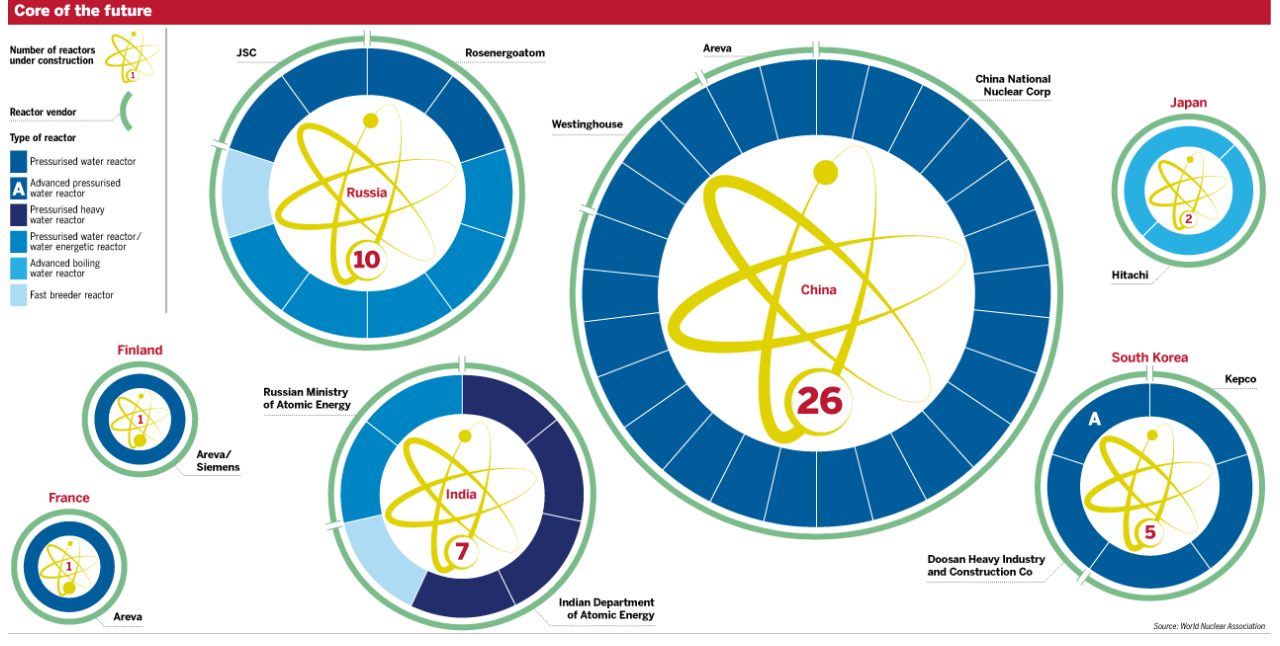
China, which is building 27 of the 62 reactors now under construction worldwide, had identified nuclear energy as a main component of its plans to shift energy consumption away from fossil fuels over the next five years. Until midweek, Beijing seemed able to ignore public nervousness, with the government and state-owned nuclear companies issuing a series of statements to reassure the public about safety. But then the State Council, or cabinet, announced a temporary freeze on all new approvals. It called for the use of “the most advanced standards” to proceed with a safety assessment of all nuclear plants under construction.

“Any hazards must be thoroughly dealt with, and those that do not conform to safety standards must immediately cease construction,” it said.

Last year, the International Energy Agency, a watchdog backed by rich countries, predicted that nuclear power would grow only modestly in importance, going from 6 per cent of total world energy use to 8 per cent by 2035. Even that rate of growth now looks difficult to attain, the IEA acknowledged on Tuesday.

To fill the gap, renewables are likely to receive a boost. But there will also be a need for a reliable power generation that works even when the sun does not shine and the wind does not blow. Gas-fired power plants are quick and cheap to build, and natural gas is plentiful in the US. It could also be abundant in Europe and China if American production techniques can be imported. Peter Voser, chief executive of Royal Dutch Shell, Europe’s largest oil and gas company, said this week he expected that even in 2050 the two main commodities his group produces will provide two-thirds of the world’s energy. That represents a rise from the current 55 per cent.

Curbing the world’s dependence on fossil fuels has always been difficult. The agonies of Fukushima will make it even harder.

Shares of Nuclear Electricity Production


From The Economist

March 13, 2011

Japan's Nuclear Quandary

From Charles Ferguson, in Foreign Policy:
Because it lacks abundant natural resources such as coal, oil, and natural gas, Japan imports more than 80 percent of its energy supplies. The 1973 oil shock from the Arab oil embargo convinced Japanese leaders that they needed to reduce their country's dependence on foreign oil. At that time, oil was used to generate about 66 percent of Japan's electricity. Nuclear energy offered a means to reduce this dependency. Today, nuclear power generates about 30 percent of Japan's electricity while oil accounts for 11 percent.
Tokyo wants to further increase nuclear power's share of electricity generation to 41 percent in 2017 and 50 percent by 2050. Japan presently has 54 commercial nuclear reactors and is building two more. It has plans for at least a dozen more in the coming decades.

From conversations I have had in recent years with Japanese nuclear energy officials, I have learned that they prefer a balanced portfolio with not too much reliance on a single source of energy for electricity. But moving toward one-half of Japan's electricity from nuclear power appears too risky in light of the recent massive earthquake. About one-fifth of Japan's nuclear plants were shut down. A prolonged shutdown of a significant portion of Japan's electric generators could affect public well-being -- for example, hospitals need reliable power supplies -- and could harm the Japanese economy.

One possible solution is to ramp up Japan's use of renewable energy sources. However, politically powerful forces stand in the way of greater development of renewable energy. Japan has 10 major electric utilities that wield tremendous political influence over local and national governments. The utility executives favor large power generators such as nuclear power plants. Wind, solar, and geothermal plants tend to be much smaller in power generation.

In 2010, the Japan Renewable Energy Policy Platform, an association of several renewable energy organizations, issued the first renewable energy white paper published in Japan. Its report underscores the lack of government incentives for increasing use of renewable energy. Japan had been in first place in the world in solar photovoltaic installation until 2004, when the government cut financial support. Moreover, renewable portfolio standards have been set too low. National targets were reached in recent years but have only resulted in a small fraction of electric power from non-hydro power sources. Furthermore, most geothermal power is not included in the renewable energy targets because of concerns about water use and the effects on spas. But geothermal has a huge potential because of Japan's location in a geologically active zone. In sum, renewable sources could provide about 67 percent of Japan's electricity by 2050 if the government would implement effective policies.

Japan, a world leader in nuclear power, should also become a leader in use of renewable energies. This will help alleviate safety and financial concerns about too much dependence on nuclear energy. It will also point the way toward a sustainable energy future for the world.
From the FT:
The International Energy Agency, the western countries’ oil watchdog, estimates that it takes about 38.8 barrels of crude oil to replace one megawatt of idled nuclear power generation capacity in Japan. If the country were to replace all its shut down nuclear capacity entirely with oil, it would have to import 375,000 barrels a day more on top of Japan’s expected purchases this year of around 4.25m b/d.
However, Japan is more likely to opt for a combination of oil, LNG and thermal coal.

The country boosted significantly its purchases of LNG in 2002, after the shutdown of 17 of Japan’s 54 reactors for safety inspections, and in 2007 and 2008 after the shutdown of the Kashiwazaki-Kariwa atomic station, the country’s largest.

The increase in LNG demand will push up spot prices globally, hitting gas prices from South Korea to the UK, but the impact will be cushioned by a relatively loose supply and demand balance as producers such as Qatar boost their supplies.

Tokyo is also likely to increase coal imports, as Japan’s utilities negotiate annual supply contracts with Australian miners. The negotiations, which face a deadline on April 1, are likely to settle annual prices in excess of the record $125 a tonne agreed in 2008-09, traders and analysts said.
Map from the New York Times: