Showing posts with label N. Coal. Show all posts

June 4, 2014

Economist to Coal Industry: Stop Your Mendacious, Homocidal, Greedy Whining

The Economist’s Democracy in America blog weighs in on industry opposition to Obama’s climate regulations:

WHAT would life in America be like if the Clean Air Act of 1970 had never been passed? In terms of breathing, an activity that's easy to overlook until it becomes difficult, it would probably resemble life in many of today's developing countries, where factories and cars are multiplying unhindered by environmental regulations. In Hanoi, where I lived in the mid- to late 2000s, the importance of breathing really started to make itself felt five or six years ago, and at that point a number of my friends decided to leave. By the time my wife and I left too, at the end of 2010, our then 8-year-old daughter had a persistent thick yellow slime in her throat that she would periodically cough up (it went away after about a year living in the clean air of the Netherlands). Things are even worse in large Chinese cities, where coal fumes, auto exhaust, smog and particulate matter are so coruscating that most Americans would consider raising a family there an act of child abuse. Rich people send their children to private schools with pressurised domes over the sports fields. Every well-off family owns an air purifier. Poor people cannot afford air purifiers; they and their children will die earlier.
American cities once looked rather similar, in the 1950s and ‘60s. And if the coal, electric power and automotive industries had had their way in the early 1970s, American cities would look like Chinese cities today, too. As Tom Zeller notes at Bloomberg View, the adoption of the 1970 Clean Air Act triggered the same kind of hysterical industry denunciations we are seeing today in response to Barack Obama's move to force the electric power industry to reduce greenhouse gas emissions. Ford Motor Company claimed the 1970 act "could cut off automobile production in just five years, lead to huge price increases for cars even if production were not stopped, do 'irreparable damage' to the American economy—and still lead to only small improvements in the quality of the air." The auto industry reprised that act in 1972, when Congress was considering forcing them to adopt catalytic converters: the vice president of General Motors said "complete stoppage of the production line could occur," while Lee Iacocca, then president of Ford, claimed it would "cause Ford to shut down", cut gross national product by $17 billion, and raise unemployment by 800,000. The mining and electric power industries made the same sorts of wild claims. In 1974, as Congress debated amendments to the act cutting sulfur emissions, the head of American Electric Power spent $3.1m on an ad campaign to convince the American public that installing scrubbers on coal-fired power plants would be a disaster. 
Needless to say, this was all nonsense. Since the Clean Air Act was signed in 1970, America's GDP has grown 212% while emissions of traditional air pollutants fell by 68%. Without the Clean Air Act's pollution reductions, adult mortality in the United States would have increased by 160,000 in 2011 alone. Over the course of 40 years, the act's pollution reductions have quite literally saved millions of lives. This follows a fairly reliable pattern: whenever the government considers environmental or safety regulations, manufacturing and energy companies and industry associations put out "studies" that grossly overestimate the costs and understate the benefits. In retrospect, the industry response to environmental regulation in the 1970s can best be described as mendacious, homicidal, greedy whingeing. 
Predictably, the US Chamber of Commerce's Energy Institute and the American Petroleum Institute have recently released reports warning of economic disaster if Mr Obama's new rules limiting greenhouse-gas emissions are implemented. The CoC report, carried out by an economic research bureau called IHS, is typical: it finds that the rules will lead American GDP to be about $50 billion per year (around 0.3% of total GDP) lower than it otherwise would be, but does not provide any estimate of the value of lower carbon and other emissions the rules will produce. This is akin to doing a cost analysis of the Clean Air Act without trying to account for the value of your kids being able to breathe. And why does IHS think the rules will lower GDP? Because of the opportunity cost of forcing utilities to replace coal-fired power plants early; this, they say, takes up capital that otherwise would have been employed in ways that generate more economic activity. How do they know that? They know it because they plugged it into their economic model, which assumes that capital generates more economic activity when its use is not dictated by regulations. Other economists have other models, some of which take into account the fact that in conditions like those we have today, with a glut of capital, low aggregate demand and little productive lending or borrowing going on, regulatory requirements can actually increase GDP by forcing companies to invest. Obviously, though, those economists would not get hired by the CoC.
The passage in the IHS report that really jumped out at me was this one:
“The required capital expenditures are essentially unproductive uses of capital because one source of electricity generation (i.e., coal-fired plants) will simply be replaced by an alternative source (i.e., natural gas–fired plants, renewables, nuclear).”
This, as far I can tell, is gibberish. The productive difference between a coal-fired power plant and a solar one is that the solar one does not produce carbon dioxide. That is the added value, just as the added value in switching from a crummy old refrigerator to a frost-free one is that you don't have to clean out the ice. The need to build solar power plants will drive the development of new technologies and of a whole new chain of suppliers, just as any other technology investment drives innovation and supports new chains of suppliers. IHS's attempt to call the switch to renewable energy "essentially unproductive" is hocus-pocus, strangely akin to the manoeuvre Soviet economists used to pull off claiming that Ladas were just as valuable as Mercedes because they're both cars.
All of which might just occasion a bit of eye-rolling, were it not for the fact that the carbon which utility companies churn out is gradually cooking the climate. It is difficult to decide what tone to adopt when speaking of organisations that spew foulness for a living, and then employ their free-speech rights to advocate for their interest in spewing more of it. Mr Zeller takes a modest, reasonable tack, writing that one should “[keep] the end-times wailing of the fossil-fuel lobby in perspective” when considering the CoC's and API’s claims. This is one way to phrase it: when considering the industry response to stronger greenhouse gas limits, one should keep in perspective that in the past they have been laughably wrong, and that the positions they have advocated would have led to the deaths of millions. But Mr Zeller also writes, in passing, that businesses can be expected to protect their bottom lines, and are "right to do so."
That's clearly true in general, but I don't think it bears any application to this situation. Even people who believe the debatable proposition that corporations have no responsibilities except to maximise shareholder return recognise that there are some limits to the arguments a business can make. Raytheon might sell more missiles if the United States were to go war against Iran, but the American public would react with disgust if a defence industry association were to put out a report arguing that war against Iran would be great for the economy. If the electric power industry wants to "talk its book", that's fine, but there need to be consensual limits set by the public's sense of the decent interests of society. The tone of hard-line, toes-in-the-dirt opposition to any and all greenhouse-gas regulation that we see from industry today is in some ways more extreme than what one saw in the 1970s; in those days, one would sometimes find business leaders expressing a recognition that they had to strike deals with government based on the broad public interest.
The obvious environmental challenge America faced 40 years ago, and which China and other developing nations face today, was the struggle for clean air. Executives in the power, mining and automotive industries made fools of themselves at the time by cooking up economic and scientific arguments against pollution regulations that turned out to be utterly wrong. Today the glaring environmental challenge is the effort to reduce carbon emissions and avoid catastrophic climate change. If America's power industry had any sense, it would have spent the past four years backing the cap-and-trade approach to reducing carbon emissions, which gives businesses more flexibility to adapt. By helping lead the campaign to defeat cap-and-trade, as Mr Zeller writes, power industry leaders have brought Mr Obama's more rigid regulatory approach on themselves. It is infuriating to see them now cough up the same tired, half-baked arguments against carbon-emissions limits that they have been making, wrongly, for four decades against the whole slate of government environmental and safety regulations—the very regulations that have made America the cleaner, safer country we know it to be. We have become so accustomed to seeing industry leaders spew this stuff out that we shrug and accept it; what do we expect them to say? We ought to expect them not to insult our intelligence. We ought to expect them to show some respect for our health, and that of the planet.
* * *
M.S., Democracy in America, “Claws in the Dirt,” The Economist, June 4, 2014.

April 19, 2014

China Limits Coal

A new report from Greenpeace (The End of China’s Coal Boom) reports on the new targets for restricting coal consumption that the state announced in September 2013. If implemented, they would make a huge contribution to reducing CO2 emissions—exceeding, Greenpeace suggests, the emissions savings expected from the EU and the US. Herewith some selections from the Greenpeace report:

China is the world’s largest energy consumer and the leading emitter of greenhouse gases. In 2013, coal accounted for 65% of China’s overall energy consumption, making it the most coal-dependent country among top energy consumers.
China accounts for almost half of global coal consumption and from 2000 to 2010 its coal use and emissions grew on average at 9% a year. In 2010 alone, China’s increase in coalfired power generation capacity equaled Germany’s existing generating capacity.
But recently adopted air quality policies and the growth of renewable energy show signs of a major change in trend. Given China’s major role in global emissions, this is of global significance. . . .
In September 2013, China’s State Council, or cabinet, released an “Airborne Pollution Prevention and Control Action Plan” in which the Chinese government recognised that tackling the air pollution crisis will require significant reductions in coal consumption. The plan was accompanied by specific coal consumption targets in provincial action plans. For the first time, the plans introduce coal consumption caps for provinces. Furthermore, many provinces are now committing to reverse the trend of rapid growth in coal use and cut their coal consumption overall in just four years. . . . If achieved, the measures will not only fundamentally shift the coal consumption trajectory of the world’s largest coal consumer, but also significantly re-shape the global CO2 emission landscape. . . .


Assuming a business-as-usual scenario where all Chinese provinces maintained 2/3 of their average rates of growth in coal consumption between 2006-2011, in line with expected slowdown in GDP growth, then the coal control measures imply reductions in coal use of 350 million tonnes by 2017 in the provinces concerned. If we assume the rate of decline was to continue between 2018 and 2020, the measures would cut 655 million tonnes of coal use from the business-as-usual scenario.
When translated into CO2 emission reductions, these reductions equal to about 700 Mt in 2017 and 1,300 Mt in 2020. (To compare, 1,300 Mt is equal to Canada’s and Australia’s total emissions combined). . . .


Implementing the existing coal control measures as planned would significantly slow down China’s CO2 emission growth. The expected reduction from business-as-usual development from the 12 regions alone (about 700 Mt by 2017 and 1,300 Mt by 2020) would bring China’s projected CO2 emissions in 2020 close to a trajectory that the International Energy Agency says would be in line with the goal of limiting global warming to 2 degrees Celsius. To get to the trajectory altogether, which would imply peaking of global energy emissions well before 2020, other big polluters will have to deliver on their emission cuts too.
China’s annual growth in coal consumption slowed to 2.8% in 2012. While this still led to significant CO2 emissions, it represented a significant deceleration from the trend over the past decade in which the country’s use of coal grew at 9% per year.


* * *
 

March 1, 2013

Gas Rising, Coal Falling, in Electricity Generation


The Breakthrough Institute comments:  

Coal electricity declined by 12.5 percent in 2012, mostly driven by the switch to natural gas, which increased by almost the exact same amount (217 terrawatt-hours) as coal declined (216 TWh), according to new annual numbers released by the US Energy Information Administration. 

Wind electricity increased as well — by about one-tenth (20.5 TWh) as much as gas. Solar increased a little more than one-hundredth as much as gas (2.5 TWh). 

The figures come at a time when renewable energy advocates have claimed that wind and solar have been responsible for the big declines in coal — claims that do not stand up to scrutiny, according to a new Breakthrough Institute analysis. 

Indeed, the new numbers highlight the key difference between gas and solar and wind. Where taxpayers subsidized unconventional gas exploration from 1980 to 2002 to the tune of $10 billion, natural gas in recent years has been replacing coal without subsidies.

Wind and solar, by contrast, remain almost wholly dependent on public support. Uncertainty last year over whether Congress would renew the key wind subsidy meant that less than half as much new wind will be installed in 2013 as was installed in 2012.

Where the problem for wind has been its high cost, the problem for gas is that it has become too cheap. Natural gas production slowed last year in the face of unprofitably low prices caused by overproduction. . . . 


On the subsequent comment thread, a pungent expression of doubt from Wilmot McCutchen:  

Pundits who are now dancing on the grave of coal need to look at the steep depletion of fracked gas wells and the growing public awareness of the danger they pose to the water supply.  What else can replace coal?  Nuclear is paralyzed by radiation fears and a history of cost overruns.  Hydro is maxed out.  Boutique solutions like wind, solar, and biofuels are not scalable to utility scale baseload generation.  So does anyone have a plan for reviving coal and mitigating its pollution?

 As against the "new abolitionism," this represents a new realism.

February 23, 2013

Clean Coal?


A press release from Ohio State University, “New Coal Technology Harnesses Energy Without Burning, Nears Pilot-Scale Development,” reports some promising research:   

A new form of clean coal technology reached an important milestone recently, with the successful operation of a research-scale combustion system at Ohio State University. The technology is now ready for testing at a larger scale. 

For 203 continuous hours, the Ohio State combustion unit produced heat from coal while capturing 99 percent of the carbon dioxide produced in the reaction. 

Liang-Shih Fan, professor of chemical and biomolecular engineering and director of Ohio State’s Clean Coal Research Laboratory, pioneered the technology called Coal-Direct Chemical Looping (CDCL), which chemically harnesses coal’s energy and efficiently contains the carbon dioxide produced before it can be released into the atmosphere. 

“In the simplest sense, combustion is a chemical reaction that consumes oxygen and produces heat,” Fan said. “Unfortunately, it also produces carbon dioxide, which is difficult to capture and bad for the environment. So we found a way to release the heat without burning. We carefully control the chemical reaction so that the coal never burns—it is consumed chemically, and the carbon dioxide is entirely contained inside the reactor.” . . . 

Though other laboratories around the world are trying to develop similar technology to directly convert coal to electricity, Fan’s lab is unique in the way it processes fossil fuels. The Ohio State group typically studies coal in the two forms that are already commonly available to the power industry: crushed coal “feedstock,” and coal-derived syngas. 

The latter fuel has been successfully studied in a second sub-pilot research-scale unit, through a similar process called Syngas Chemical Looping (SCL).  Both units are located in a building on Ohio State’s Columbus campus, and each is contained in a 25-foot-high insulated metal cylinder that resembles a very tall home water heater tank. . . . 

The researchers are about to take their technology to the next level: a larger-scale pilot plant is under construction at the U.S. Department of Energy’s National Carbon Capture Center in Wilsonville, AL. Set to begin operations in late 2013, that plant will produce 250 thermal kilowatts using syngas. 

The key to the technology is the use of tiny metal beads to carry oxygen to the fuel to spur the chemical reaction. For CDCL, the fuel is coal that’s been ground into a powder, and the metal beads are made of iron oxide composites. The coal particles are about 100 micrometers across—about the diameter of a human hair—and the iron beads are larger, about 1.5-2 millimeters across. Chung likened the two different sizes to talcum powder and ice cream sprinkles, though the mix is not nearly so colorful. 

The coal and iron oxide are heated to high temperatures, where the materials react with each other. Carbon from the coal binds with the oxygen from the iron oxide and creates carbon dioxide, which rises into a chamber where it is captured. Hot iron and coal ash are left behind. Because the iron beads are so much bigger than the coal ash, they are easily separated out of the ash, and delivered to a chamber where the heat energy would normally be harnessed for electricity. The coal ash is removed from the system. 

The carbon dioxide is separated and can be recycled or sequestered for storage.  The iron beads are exposed to air inside the reactor, so that they become re-oxidized  be used again. The beads can be re-used almost indefinitely, or recycled. 

Since the process captures nearly all the carbon dioxide, it exceeds the goals that DOE has set for developing clean energy. New technologies that use fossil fuels should not raise the cost of electricity more than 35 percent, while still capturing more than 90 percent of the resulting carbon dioxide. Based on the current tests with the research-scale plants, Fan and his team believe that they can meet or exceed that requirement. 

The DOE funded this research, and collaborating companies include Babcock & Wilcox Power Generation Group, Inc.; CONSOL Energy, Inc.; and Clear Skies Consulting, LLC.

Note that this new technology does not propose a solution to the problem of how to store or recycle the carbon dioxide the process produces. As such, it seems rather inconclusive in its implications.

December 23, 2011

Coal Retreats Before Natural Gas

 
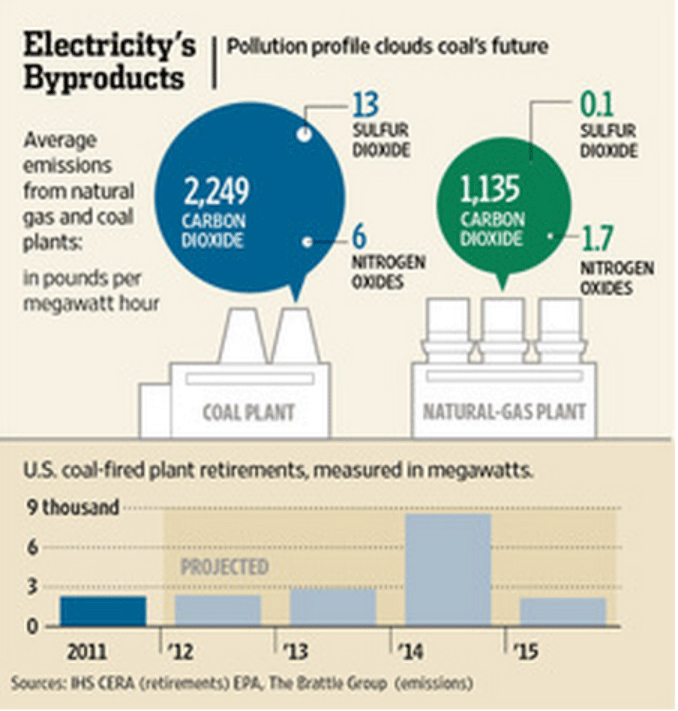
New regulations from the Environmental Protection Agency, together with potent competition from natural gas, are putting pressure on coal plants in the United States, according to The Wall Street Journal. From a global perspective, the low natural gas price that prevails in the United States is something of an anomaly, so the significance of this development should not be overstated. The relative emissions produced, respectively, by coal and natural gas must include consideration of the full cycle of production and consumption, and it is not clear whether the  attached graphic from the Journal does so. From the Journal:

For decades, coal produced more electricity than all other fuels combined, and as recently as 2003 accounted for almost 51% of net electricity generation, according to the U.S. Energy Information Administration.

But its share has dropped sharply in the last couple of years. It fell to 43% for the first nine months of 2011, as natural gas's share has jumped to almost 25% from under 17% in 2003. Meanwhile, gas prices, on average, have fallen 37 cents to $4.02 per million British thermal units so far this year.

Many big utilities have announced retirements of coal-burning power plants, including Southern Co., Progress Energy Inc., First Energy Corp., Xcel Energy Inc., Ameren Corp. and the Tennessee Valley Authority.

Coal consumption by the power sector is expected to fall 2% this year and 4% next year; even small movements are important because utilities burned 92.4% of the 1,071 million short tons of coal distributed last year in the U.S.

American Electric Power Co., the biggest user of coal in the U.S., expects to burn 67 million tons of coal this year but anticipates its consumption will drop to 50 million tons after it retires 25 coal-burning generating units in six states by 2015.

Experts think 10% to 20% of U.S. coal-fired generating capacity will get shut down by 2016.

Some of the soon-to-be-defunct plants have been operating only sporadically because they are old, inefficient and expensive to operate; Duke Energy Corp.'s Beckjord plant in Ohio, for example, didn't even run three of its six generating units in 2010.

Market and regulatory forces are "sounding a death knell for many an older coal-fired power plant," says Hugh Wynne, senior research analyst for Sanford C. Bernstein & Co. in New York.

John Stowell, vice president of energy and environmental policy atCharlotte, N.C.-based Duke, says the EPA rules are triggering "an aging baby-boomer-type situation," that will force a record number of retirements —and soon.

The coal and mining industries have opposed the new EPA regulations as job-killers, though some coal companies have job openings they can't fill. The communities that are home to the closing plants will lose jobs and tax revenues.

Closing Beckjord, for example, will eliminate as many as 120 jobs at the plant, according to Duke. The loss of tax revenues will cost the local school district in New Richmond, Ohio, about $2 million a year, says Teresa Napier, the district's chief financial officer. People are sorry to see the jobs go, but they understand why it is happening, she says, because "people want clean air."

Meanwhile, natural-gas plants are springing up around the country, from Connecticut to California. More are expected to crop up along natural-gas pipelines, especially in places like Texas where demand for power is outstripping supplies.

Duke, for example, is building four big power plants. Two, in the Carolinas, will burn natural gas. One, in Indiana, will convert coal to a cleaner, combustible gas. Only one, in North Carolina, will burn coal.

Cost is a big reason for the shift away from coal. Coal prices have jumped an average of 6.7% a year for the past decade, according to the U.S. Energy Information Administration. Coal cost $12 to $75 per short ton in early December, depending on where it was mined and how hot it burns.

And with energy markets flooded with cheap natural gas from shale rock, utilities have been idling coal capacity and running gas-fired plants harder. Fitch Credit Ratings estimates this is whittling coal sales by 63 million tons a year, equivalent to 6% of 2010 U.S. coal consumption. Fitch says the new EPA regulations could reduce coal sales by another 55 million tons a year, or 5% by 2016, due to plant retirements. Hardest hit: central Appalachian coal, due to its emissions profile.

Coal-firm shares have shown the strain. Peabody Energy Corp.'s stock has dropped by half since April, to $34.54 from a 52-week high of $73.95 set that month, and Consol Energy Inc.'s stock is off by a third since March to $38.38 from a 52-week high of $56.32 set that month.

But the new EPA rules are also significant. On Wednesday, the agency released its latest rule, requiring power plants to slash emissions of mercury, arsenic and other toxic pollutants within three to four years.

Last July, the agency released its final Cross-State Air Pollution Rule, which requires reductions of sulfur-dioxide and nitrogen-oxide emissions in 23 Eastern and Midwestern states beginning next year, as well as seasonal ozone reductions in 28 states.

The EPA also is working on rules to limit the amount of water drawn from natural waterways by power plants for cooling purposes and to control the handling and storage of coal waste. Many state utility commissioners say they fear the agency's recent rules will push up electricity prices or could even hurt electric-system reliability if too many power plants are shut down.

Stan Wise, an elected utility commissioner in Georgia, says "implementation of the rules has got us in a tizzy." He has written the EPA to express his objections.

EPA Administrator Lisa Jackson said the new mercury and toxics rule will deliver $37 billion to $90 billion in health benefits, per year, when fully implemented after 2016. "These are not abstract statistics or numbers," she said on Wednesday, but mean better health for millions of Americans. . . .

Rebecca Smith, "The Coal Age is Nearer to Its End," Wall Street Journal, December 23, 2011

June 10, 2011

Top 25 Mercury Emitting Coal Plants


From Climate Progress, reporting a study by the Environmental Defense Fund, on the real costs of coal. CP comments: "There are 600 coal plants in the U.S. These 25 coal plants emit roughly 30% of total mercury pollution in the U.S. electricity sector. The harm from coal, if it were actually added to the cost of their power, would make these plants uneconomic." (see Life-cycle study: Accounting for total harm from coal would add “close to 17.8¢/kWh of electricity generated”)

June 9, 2011

World Coal Consumption Grows by 7.6% in 2010


Schumpeter at the Economist has some figures from BP's latest report on world energy:
Most of China’s growth came from burning more coal: in 2000 China accounted for just under a third of world coal use; in 2010 a staggering 48.2%. Repeat that sort of expansion on a smaller scale for a number of other countries and you see why coal is going up in the global mix. You also see why the world’s energy-related carbon-dioxide emissions have grown even faster than its energy use—by 5.8% last year, on BP’s figures. That is the fastest growth since 1969.

The shift in production from developed to emerging economies doesn’t just decrease global energy efficiency; it also increases emissions for any given amount of energy use. The less energy-efficient economies also tend to be the heaviest coal users. [Chistoph Rühl, BP's chief economist,] points to the intractability this adds to the problem of emissions; even if emerging economies are reducing their carbon intensity (the amount of carbon emitted per unit of output), global carbon intensity can continue to rise if production shifts to those emerging economies fast enough. Hence record growth in emissions despite modest but real commitments to emissions control in both emerging and developed economies.

May 20, 2011

China's Coal Problem

Coal has played a huge role in China's development; Richard Heinberg says "it may not be an oversimplification to say that the fate of China’s economy rests on its ability to maintain growth in coal supplies." Heinberg also explores the problems of China's investment led export boom and vulnerabilities it has from an aging population, but it is the physical restraint he begins with and which he evidently thinks is primary.
China relies on coal for 80 percent of its electricity and 70 percent of its total energy; coal also supports China’s steel industry, the world’s largest. Altogether, China is one of the most coal-dependent nations in the world. In order to become the world’s second-largest economy, it has had to more than double its coal consumption over the past decade, so that it is now using nearly half of all coal consumed globally, and over three times as much as is consumed in the next nation in line, the U.S. (which prides itself on being “the Saudi Arabia of coal”). . . .
The nation has recently updated its proven coal reserves to 187 billion metric tons, putting it second in line after the U.S. in terms of supplies. That would be about 62 years’ worth of coal at 2009 rates of consumption (over three billion tons per year). But this simple “lifetime” calculation is highly misleading.
Reserves lifetime figures are calculated on the basis of flat demand and lose meaning if demand grows over time. China’s coal consumption is accelerating rapidly, so that the expected “62 years’ worth” must be adjusted downward. Demand forecasts from China’s Energy Research Institute would reduce the reserves lifetime to about 33 years; but if coal demand were to grow in step with projected Chinese economic growth, the reserves lifetime would drop to just 19 years.
Yet this still doesn’t capture the situation. Production will peak and decline long before China’s coal completely runs out. Further, as with oil production, coal mining proceeds on the basis of the “best-first” or “low-hanging fruit” principle, so we must assume that China is extracting its highest-quality, easiest-accessed coal now, leaving the lower-quality and more expensively mined coal for later. Unlike the U.S., China does not have vast deposits of surface-minable coal; over 90 percent of China’s coal comes from underground mines up to 1,000 meters in depth, and those mines face increasing engineering challenges.. . .
China has few options for reducing its reliance on coal, since the fuel is used in so many ways. In addition to powering the electricity and steel sectors, coal provides winter heat to hundreds of millions of northern Chinese; it is also used in the cement, non-ferrous metals, and chemicals industries. While China is rapidly expanding its supply of natural gas,to replace just the coal used for heating would double total gas consumption.
China is quickly developing alternative energy sources. But can these be brought on line fast enough to make a difference? Let’s do some numbers. China aims to have 100 gigawatts (GW) of wind power capacity by 2020, and the nation’s leaders plan to expand installed solar capacity to 20 GW during the same period. These are truly astonishing goals, and, if China even comes close to accomplishing them, it will become the world’s renewable energy leader. But there is a problem. Total Chinese electricity generation capacity is 900 GW currently; with seven percent growth, that means the nation’s electricity demand in 2020 will be something like 1800 GW. Wind and solar together would supply less than seven percent of that. The only thing likely to boost that percentage much would be a dramatic reduction in growth of energy demand to, say, two percent annually.
The situation with nuclear power is similar: China has 11 atomic power plants now and is in the process of building 20 more, with a target of 60 GW of generating capacity, or possibly more, by 2020. But this will supply only between three and five percent of total electricity demand, depending on energy demand growth rates. In late 2010, energy policy makers in Beijing evidently began to take notice of the looming electricity supply problem, and rumors circulated of new efforts to construct up to 245 new nuclear plants over the next two decades (the U.S. has only 104 in total). If this new target is real, and if the Chinese succeed in achieving it, a large fraction of new electricity demand for the coming years could be met through sources other than coal—but China would still have an enormous (though more slowly growing) coal dependence to feed. Meanwhile, China’s soaring demand for uranium would push up global prices for this energy mineral.
In 2009 China was a substantial net importer of coal, having been a net exporter every year through 2008.[7] China could import more coal to enable further growth, but the biggest exporters of coal—Australia, Indonesia, and South Africa—have much smaller reserves and production rates. The entire seaborne trade in steam coal (mainly used by power plants) currently amounts to only 630 million tons per year, and China could absorb this much with only three years of continued growth in coal demand. That’s not going to happen, though: Other nations need that export coal, too—including India, also a major coal-based economy, and also a country needing to import increasing amounts of fuel.
The conclusion is unsettling but inescapable: China’s reliance on coal cannot be significantly reduced as long as its demand for electrical power continues to grow at anything like current rates. And even if energy demand growth tapers off and alternative energy sources come on line quickly, the country’s ability to supply enough coal domestically will still be challenged. This will drive up coal prices worldwide, while choking off economic growth at home. China’s energy economy is unsustainable and will cease growing in the foreseeable future, impacting many other nations as it does so.

May 17, 2011

Wishful Thinking: Replacing Coal with Natural Gas


This innovative map from the Post Carbon Institute (original source here) shows the location and relative size of U.S. electrical generating capacity. Expectations that natural gas might replace coal in electricity generation are wishful thinking at best, according to the Institute. Not only are reserves of natural gas greatly exaggerated, but there are also serious limitations in infrastructure. According to a study by the Aspen Environmental Group, these include "the lack of sufficient pipeline capacity in 21 states as well as the lack of storage capacity on the East Coast, in the Central Plains states, and in Nevada, Idaho, Arizona, and Missouri." Looking at the map suggests, quite strikingly, that a vast area stretching from Illinois and Missouri in the west to Pennsylvania to Georgia in the east is entirely dominated by coal and nuclear.

May 9, 2011

Nuclear Power Better than Alternatives?

Ted Nordhaus and Michael Schellenberger of The Breakthrough Institute insist that the real alternative to nuclear power is not renewables but fossil fuels, and write caustically that most environmentalists are their own worst enemy:
Fukushima showed that, for most environmentalists, nuclear’s low-probability risks trump both the existential threat of climate change and 2m deaths annually from air pollution. Green campaigners have, ironically, fallen prey to the same misperception of risk they all too often see in a public indifferent to global warming: an obsession with dramatic but infrequent threats, while ignoring those that are banal but far more deadly. 
Many greens dismiss this criticism by claiming that the choice between nuclear and fossil fuels is false. But in this, environmental hysteria about nuclear power is matched by green delusions about renewable energy. Since at least the 1970s, greens have argued that wind and solar, when combined with energy efficiency, could meet our energy needs without resort to nuclear power or fossil fuels. Faith in what is called the “soft energy path” has taken on an almost religious quality among green activists. Yet, despite decades of subsidies, solar and wind still make up a tiny percentage of energy virtually everywhere in the world. 
Anyone who thinks turning away from nuclear will lead to more renewables need only look at what has happened in Germany. After Fukushima, it shut down seven of its 17 nuclear plants. The result has been that emissions have risen as much as 10 per cent, according to Reuters, partly due to electricity imports from coal-burning nations such as the Czech Republic. 
Germany promises that more of its future electricity will come from renewables, but if it shuts down its entire nuclear fleet the replacement power will come primarily from coal and gas. Indeed, while greens have fawned over its much-vaunted solar subsidies programme, Germany has actually been on a coal building boom, bringing 11 gigawatts of coal-fired generation online – six times the electricity it gets from solar – in the past 10 years alone.
Put simply, there is no credible path to stabilising, much less reducing, global carbon emissions without more nuclear power. We are a planet of 6bn people, heading toward 9bn. Even with better energy efficiency, global energy demand will soon double, perhaps triple. Without nuclear power, the vast majority of that demand will be met by fossil energy.
While effective coal usage has gone up in Germany since the nuclear shut down, in the long term Prime Minister Angela Merkel's government is deeply committed to a transition from nuclear and coal to renewables--not just that "more of its energy will come from renewables." This makes Germany the great laboratory for a rapid transition to renewables. From Yale Environment 360:
In mid-March, Merkel stunned the German public and other governments by announcing an accelerated phasing out of all 17 German nuclear reactors as an immediate reaction to the Fukushima disaster in Japan. The chancellor now says she wants to slash the use of coal, speed up approvals for renewable energy investments, and reduce CO2 emissions drastically. That means that the 81 million Germans living between the North Sea and the Alps are supposed to cover their huge energy needs from wind, solar, geothermal, and biomass within a few decades. Indeed, by 2030 green electricity could be the dominant source of power for German factories and households.

“We want to end the use of nuclear energy and reach the age of renewable energy as fast as possible,” Merkel said. . . . 
Merkel’s administration plans to shut down the nuclear reactors — which in recent years reliably provided up to a quarter of Germany’s huge needs as baseload electricity — by 2022 at the latest. It wants to double the share of renewable energy to 35 percent of consumption in 2020, 50 percent in 2030, 65 percent in 2040, and more than 80 percent in 2050. At the same time, the chancellor vows to cut CO2 emissions (compared to 1990 levels) by 40 percent in 2020, by 55 percent in 2030, and by more than 80 percent in 2050.

That makes Germany the world’s most important laboratory of “green growth.” No other country belonging to the G20 club of economic powers has a comparable agenda. . . . 
"It’s over,” she told one of her advisers immediately after watching on TV as the roof of a Fukushima reactor blew off. “Fukushima has forever changed the way we define risk in Germany.”

Merkel’s conservative environment minister, Norbert Röttgen, recently echoed this line of thinking when he said that the Fukushima disaster “has swapped a mathematical definition of nuclear energy’s residual risk with a terrible real-life experience.” He added: “We can no longer put forward the argument of a tiny risk of ten to the power of minus seven, as we have seen that it can get real in a high-tech society like Japan.”

The new course is a huge challenge in terms of cost and feasibility. Of the current 82 gigawatts of peak demand, about half comes from coal, 23 percent from nuclear, 10 percent from natural gas, and 17 percent from renewables. That means three quarters of Germany’s electricity sources will have to be replaced by green technology within just a few decades, if the nuclear phase-out and the CO2 goals are to be accomplished. . . . 
Merkel’s big hope for her “energy turn” is offshore wind energy. After a sluggish start, several new commercial projects are under construction. On May 2, Merkel proudly pressed a button at a ceremony on the Baltic Sea coast, setting in motion 21 huge offshore wind turbines 16 kilometers away at sea. Taken together, they can provide 50,000 households with renewable energy. . . .
Japan is moving in a direction very similar to that of Germany, with the government of Naoto Kan announcing that Japan would give up its plans to build more nuclear power plants. The decision, writes the New York Times,
will mean the abandonment of a plan that the Kan government released last year to build 14 nuclear reactors by 2030 and increase the share of nuclear power in Japan’s electricity supply to 50 percent. Japan currently has 54 reactors that before the earthquake produced 30 percent of its electricity. . . . 
The announcement Tuesday came just days after Mr. Kan said Japan remained committed to nuclear power. His apparent pull-back may be driven partly by public opinion, which has significantly soured on nuclear power since the Fukushima accident.  
Even before the announcement, the disaster had damped the nuclear industry’s hopes for a worldwide revival of reactor building. With demand for electricity and concerns about global warming both growing, the industry had projected rapid expansion, but Japan’s nuclear crisis had already caused several countries to become skittish about nuclear power. . . . 
Still, several experts and nuclear industry representatives said Tuesday that they expected demand in two important markets — China and India — to remain strong even though those counties had said they would proceed more cautiously. Both nations have rapidly growing demand for electricity, and neither has nearly enough domestic fuel to meet its needs.  
Nils J. Diaz, a former chairman of the Nuclear Regulatory Commission and a consultant for companies that want to build reactors, said he did not think the prime minister’s announcement would cause “a domino effect.” And Jonathan Hinze, vice president for international operations at the Ux Consulting Company in Roswell, Ga., which tracks the market for reactors, added that Japan’s suspension of new reactor building was less damaging than it seemed because many in the industry had doubted that Japan would have the demand to justify that much construction.   
A downturn in reactor construction would hurt Japanese companies that export nuclear plant designs and components, including Toshiba, which owns Westinghouse, and Hitachi, which is in a worldwide partnership with General Electric. Companies in France and South Korea also have a big stake in reactor building.  
On Tuesday, Mr. Kan said Japan would retain nuclear and fossil fuels as energy sources, but vowed to add two new pillars to Japan’s energy policy: renewable energy and conservation. While Japan has been a global leader in energy conservation, it lags behind the United States and Europe in adopting solar and wind power, and other new energy sources.  
“We need to start from scratch,” Mr. Kan told reporters. “We need to make nuclear energy safer and do more to promote renewable energy.” 
The wording seemed to at least leave open the possibility that some new nuclear plants could be built in the future.  
On Tuesday, Japan was reminded of the human costs of the Fukushima disaster, when the first group of 92 people paid two-hour visits to their homes in Kawauchi, within the 12-mile zone around the plant that was evacuated after the nuclear crisis.  
The residents wore white antiradiation clothing and traveled in buses under tight supervision by nuclear officials. They retrieved belongings like photo albums and the tablets traditionally used in Japan to honor dead relatives in household Buddhist shrines, according to local media reports.  
The government appeared to agonize for weeks over whether to allow even brief trips. Officials were concerned about whether civilians could be kept safe from exposure to potentially high radiation doses near the plant.  
Complicating their decision was the lack of scientific knowledge on the health effects of the radiation doses now found in many of the evacuated areas. Some scientists say radiation levels even in many evacuated areas are too low to cause immediate illness, while others worry that the incidence of cancer could rise over the long term.       
Nuclear power has suffered a comparable setback in the United States, where, in addition to safety concerns, it faces competition from cheap natural gas. A very significant divide is emerging between the "advanced industrialized democracies" and developing giants like China and India over the role of nuclear power in their energy mix.

The latest FT survey (May 30, 2011) has nuclear power bent but not broken from Fukushima: while sharp cutbacks are planned in Germany, in Japan the government still remains committed to getting 30% (rather than the more ambitious 50%) of Japan's electricity from nuclear by 2030, and "most of the leading countries that have planned to build new reactors, including China, France, the UK and South Korea, have been sticking to those plans." Growth in the nuclear power industry "will be slowed but not stopped."

March 29, 2011

More Coal from the Powder River Basin


 From Wild Earth Guardians:
Although the American West holds enough renewable energy potential to fully power the entire United States, Secretary of Interior Ken Salazar today announced at a press conference that he intends open the door for 2.35 billion tons of new coal mining in the Powder River Basin of Wyoming.
When burned, the coal threatens to release more than 3.9 billion tons of heat-trapping carbon dioxide, equal to the annual emissions from 300 coal-fired power plants, further cementing the United States as a leading contributor to climate disruption. Furthermore, coal’s pollution is dangerous to public health and contributes to four of the five leading causes of death in the United States.

“We can’t achieve a clean energy future by mining 2.35 billion tons of coal,” said Jeremy Nichols, Climate and Energy Program Director for WildEarth Guardians. “Rather than look ahead to our energy future, Secretary Salazar seems content to keep looking in the rearview mirror, keeping this country dangerously dependent on dirty energy.”

Salazar’s announcement is a stark contrast to his call for clean energy. Interior, for example, touted that in 2010, 4,000 megawatts of renewable energy development were authorized. And in today’s press conference, Secretary Salazar announced Interior’s intent to authorize more than 12,000 megawatts of renewable energy by the end of next year.