Showing posts with label M. Natural Gas. Show all posts

August 13, 2014

Ukraine's Gas Woes

James Stafford of Oilprice.com has the goods on Ukraine’s recent energy legislation: 

Ukraine doesn’t need Russia to take it down—Kiev is doing fine destroying itself, most recently with a new tax code that doubles taxes for private gas producers and promises to irreparably cripple new investment in the energy sector at a time when reform and outside investment were the country’s only hope.
Ukrainian President Petro Poroshenko on August 1 signed off on a new tax code that effectively doubles the tax private gas producers in Ukraine will have to pay, calling into question any new investment, as well as commitment from key producers already operating in the country.
The stated goal of the new tax code—a legislative package embraced by the parliament on July 31 with more than 300 votes--is to raise $1 billion, of which $791 million would go to fund the war effort in eastern Ukraine.
According to the Kyiv Post and Ukrainian law firms, the new code will remain in force until the end of 2014 during which time gas drillers will be required to pay 55 percent of their subsoil revenue for extracting under five kilometers. This is up from 28 percent--so it’s a significant hit for producers. Additionally, for any extraction beyond five kilometers, the tax will be 28 percent--up from 15 percent.
The only saving grace here is that this wasn’t the worst possible scenario: An early version of the bill called for a 70 percent tax on gas extraction.
Ukraine may have some of the most attractive gas prices in the world—the only thing that could have possibly lured investors there—but the new tax law renders this irrelevant, especially considering that in European countries, the tax does not exceed 20 percent.
The oil sector will also be hit with the new tax code, which increases rates to 45 percent for drilling under five kilometers—up from 39 percent. But it is the gas tax hike that will really cripple potential investment in Ukraine.
Private gas producers lobbied energetically against the new tax laws, arguing that it will crush investment and force investors to re-think their commitment to Ukraine. They also argue that it benefits some members of the political-business elite, and has nothing at all to do with funding the war effort in the east. Instead, it is the next phase in the battle among energy oligarchs to secure their interests in the dynamic political arena shaping up after the fall of President Viktor Yanukovych.
In an open letter sent to Parliament on July 29, a group of private producers stated: “The draft law may lead to a rapid increase in the tax burden on private gas producing companies, a significant decrease in project cost effectiveness in general (up to closing down due to unprofitability) and a general decrease in attractiveness of the Ukrainian market for foreign investors."
Speaking to Oilprice.com from Kiev, Robert Bensh—a veteran Ukraine energy executive and partner and managing director of Pelicourt LLC, the majority shareholder in Ukraine’s third-largest gas producer, Cub Energy—was highly critical of the new tax law and fearful of what it means for Ukraine’s future at such a critical juncture its energy dynamics.
“This law is dangerous to the long-term security of Ukraine. It adds little to the budget and discourages drilling and investment in the upstream oil and gas sector, as well as calls into question the ability to invest in Ukraine at all,” said Bensh, who has been one of the most visible lobbying forces against the law.
“No one will invest in a country that arbitrarily punishes investors who are creating value by increasing reserves and production, or who are paying taxes and employing hundreds of thousands of people. No one will invest in an industry with the risk that taxes will be double or triple within a few months,” he said.
Bensh called the bill “highly political” and pointed to its two key beneficiaries: energy magnates Rinat Akhmetov and Ihor Kolomoyski, who “either own oil or mining assets that were taxed immaterially and punitively taxed gas producers.”
According to OP Tactical’s intelligence wing, the tax code was clearly maneuvered by Akhmetov and Kolomoyski and should serve as the first sign that key reforms of the energy sector will be challenged at every step to ensure that these interests are secured at the expense of the state.
“The failure of Ukraine to develop gas supplies, either due to years of corruption and or failure to attract outside investment into the upstream sector, is a material factor in Ukraine's current economic crisis and issues with Russia. Ukraine has always sought the easy solution.  This tax and the failure to see the strategic impact upon the country is yet again another example,” Bensh said.
* * *
James Stafford, “Who Needs Russia? Ukraine Will Destroy Itself with New Gas Tax,” Oilprice.com, August 7, 2014. Stafford has a August 12 update here, citing the protests of Cub Energy, Geo Alliance, Burisma, Kub Gas, and Regal Petroleum. They warn that “the 55 percent tax rate could ‘lead to the collapse’ of large- and medium-scale projects in Ukraine.”  Extension of the tax beyond the end of 2014 will lead these firms to leave Ukraine and mean “no further foreign investment in the country’s beleaguered gas sector.”

May 4, 2014

Austria and Bulgaria Defy EU over Russia's South Stream

The following report details how Austria and Bulgaria, with the implicit support of Germany, have defied the EU’s attempt to thwart Russia’s South Stream natural gas pipeline. Henning Gloystein of Reuters explains how “Side deals with Moscow thwart drive to wean Europe off Russian gas” (May 4)

* * *
While officials in Brussels were calling for Europe to reduce its dependency on Russian natural gas and negotiate with Moscow as a bloc, Austria was quietly bypassing the European Commission to cut its own bilateral deal on building a pipeline.

The deal on the South Stream pipeline, which will be built under the Black Sea to Bulgaria and on to central Europe, shows the European Union's difficulty in creating a unified energy policy on Moscow during the Ukraine crisis.

While EU officials are calling for Europe to wean itself off Russian gas, private and state-owned firms, with the support of politicians, are pushing ahead with projects to buy ever more.

Austrian energy firm OMV agreed last week with Russia's state-controlled Gazprom to bring the South Stream pipeline to Austria's Baumgarten gas hub, outmanoeuvring Italy which had wanted it to end there.

The deal is also likely to please some in neighbouring Germany, as the gas will now be delivered closer to customers.

It shows that when it comes to natural gas diplomacy, European countries still have their own competing interests which are difficult to unite under an EU flag.

The timing of the deal, which coincided with Europe announcing new sanctions on a list of Russians designed to push the Kremlin to reduce its support for separatists in Ukraine, could hardly have been more at odds with official EU policy.

The Commission had put the approval process for South Stream on hold after Russia annexed Ukraine's Crimea region in March, hoping the delay would push Moscow to stop what the West says is its intervention in Ukraine.

Brussels says South Stream does not comply with its regulations on ownership and pipeline access. But Austria and Russia have circumvented this by announcing that their deal is based on a bilateral agreement between the countries rather than an EU accord.

South Stream's main purpose, like the German-Russian Nord Stream pipeline under the Baltic Sea, is to circumvent Ukraine. This would ensure that disputes between Moscow and Kiev do not interfere with the flow of Russian gas to Europe, much of which crosses Ukraine in existing pipelines.

"If we agree to South Stream, Europe will sell the rope with which Russia will hang Ukraine, and it will also agree to increase its energy dependency on Russia," said Frank Umbach, at the European Centre for Energy and Resource Security (EUCERS), a research team at King's College London.

PAST FAILURE MOTIVATES DEAL

Austria was motivated to push for the South Stream deal after it lost out to Italy in a competition last year over a separate pipeline bringing gas to Europe from Azerbaijan.

OMV's Nabucco pipeline project was dropped in favour of the rival Trans-Adriatic Pipeline (TAP) to Italy. That derailed years of Austrian lobbying, which the EU had initially backed, for Nabucco to bring the Azeri gas to central Europe.

"Current international developments show once again that in the long-term we don't only have to diversify our energy sources, but also our routes," said Austrian economy and energy minister Reinhold Mitterlehner. "Should the South Stream pipeline end in Baumgarten, we will get closer to this target."

Gazprom sources said they had been approached during the last four weeks by Austria, and a deal was put together as fast as possible.

Gazprom and OMV aim to get the remaining permits by the end of next year and start delivering gas by 2017.

"For Russia, this project is a clear signal to Ukraine that it intends to avoid any future disputes or supply disruptions," said Friedbert Pflüger, director of EUCERS. "The reference to a 2010 bilateral agreement for regulatory approval demonstrates Moscow's intention to circumvent the EU's regulations that would make the realisation of the project more difficult."

UNDERMINING BRUSSELS

The Gazprom-OMV agreement continues Russia's strategy of making bilateral deals that undermine the Commission, the EU's executive arm, which wants to build up a European front on energy supplies.

Bulgaria, which imports almost all its gas from Russia, also backed South Stream last month in defiance of Commission calls that member states should not enter bilateral deals with Gazprom without its approval.

"South Stream is a project of strategic importance. Now they (the European Parliament) want to stop South Stream. How are we to develop? This crisis at the moment shows that we do not have security of natural gas supplies for Bulgaria," energy minister Dragomir Stoynev said.

Quietly supporting smaller EU member states such as Austria and Bulgaria is Germany, where the government has said it sees Moscow as a reliable gas supplier and industry has made big investments in securing Russian gas.

Germany is by far Gazprom's biggest customer in the EU, paying around $15 billion a year for Russian gas.

After years of lobbying by former German chancellor Gerhard Schroeder, the Nord Stream pipeline began operations in 2011.

Schroeder chairs Nord Stream's board and has been an outspoken critic of moves to isolate Russia diplomatically. He drew strong criticism in the German press last week for bear-hugging President Vladimir Putin during a visit to Russia.

South Stream's proposed 2,500 km (1,500 mile) route would stretch from Russia under the Black Sea through Bulgaria and Serbia to Hungary and now Austria.

Germany's BASF, the world's biggest chemicals company, is a partner in South Stream through its gas supply subsidiary Wintershall.

The head of BASF's advisory board is Eggert Voscherau, brother of Henning Voscherau, who is chairman of South Stream Transport's board of directors and a prominent former politician of Schroeder's Social Democratic Party.

A government adviser in Berlin, speaking on condition of anonymity said Berlin was happy that the new pipeline was now going to Austria rather than Italy: "Bringing South Stream's gas to Austria is far better for Germany's industry and gas security than pumping it far to the South to Italy."

Source: Johnson's Russia List, May 4, 2014
 
* * *

Update: The FT has further detail on the new pipeline politics:

This week, Gazprom signed a preliminary deal with the energy company OMV to build a spur of South Stream into Austria. It also announced deals with Switzerland’s Allseas Group and Italy’s Saipem to build South Stream’s submarine pipelines in the Black Sea. Many of the project’s pipes are being manufactured by the German company Europipe.
“[Russian President Vladimir] Putin is using South Stream to undermine the EU and its cohesive energy policy from within,” said Ilian Vassilev, an energy consultant and Bulgaria’s former ambassador to Russia. EU countries with interests in the project – Italy, Germany, Bulgaria, Hungary and Austria – are all reticent about imposing broad economic sanctions on Russia.

The deals with OMV, Saipem and Allseas come amid a crucial dispute in Bulgaria that cuts to the heart of whether the EU can use competition law to undermine Gazprom. Bulgaria is a key battleground because construction work is due to start there in June and its socialist government has some of the EU’s strongest ties to Russia.
The arguments centre on EU policies called the “third energy package”. These measures are intended to prevent a monopolistic supply chain and would limit the volume of gas that Gazprom could export to the EU, even to a point where the company could only supply half of the pipeline’s gas. Analysts argue this would weigh on the project’s profitability. Russian officials have stressed the importance of winning exemptions from the competition rules but Brussels is signalling that it is unlikely to grant Gazprom any leeway.

Bulgaria’s parliament has opened a new front to support Gazprom by seeking to amend its energy law and exempt the offshore pipeline from EU rules. The commission has reacted sternly to what it sees as a test of its resolve, warning Bulgaria that submarine pipelines are still subject to EU law and adding that Sofia could face “legal steps”.
The EU’s inflexibility over the third energy package is an obstacle for Gazprom as it needs to arrange financing for South Stream. The first gas supplies are due to be delivered next year. In a sign of its concern, Russia has launched a dispute over the EU’s third energy package at the World Trade Organisation.

“What they are most concerned about is that the EU can sabotage South Stream,” said Jonathan Stern of the Oxford Institute for Energy Studies, who is a member of the EU-Russia Gas Advisory Council. Russia has a key strategic interest in wanting to diversify its exports away from Ukraine. With 63bn cubic metres of planned capacity, South Stream would be able to replace almost entirely the volume of gas that currently transits Ukraine – planned at 70bcm this year,
Earlier this year, Gazprom had been on the point of winning an important exemption to the competition rules to supply extra gas to Germany. Russian officials had hoped that this was a sign that the commission could also be flexible on South Stream. But commission officials now say that decisions on exemptions from the third energy package are on ice for political reasons.

Still, Mr Vassilev said that Russia was likely to pay for South Stream from its own treasury if commercial lenders were deterred by the EU’s stance. He said that Mr Putin would seek to defend the pipeline as “a huge lever”.
“They would use state money to be seen to be in a position to ignore European Commission concerns,” he said.

Europe’s rifts are growing. Italian oil companies Eni and Saipem have important stakes in its construction, although a spur into Italy itself is in doubt. While Hungary has not rallied to defend South Stream as vocally as Bulgaria’s government, Budapest has aligned its energy policy with Moscow more closely this year by granting it a multibillion-dollar nuclear reactor deal. Serbia, which is applying for EU membership, also supports the pipeline.
Ironically, Professor Stern noted that the crisis was likely to make pipelines bypassing Ukraine, such as South Stream, even more important for European energy supplies: “We may be in a situation where we will be accusing Russia of not delivering and preventing them from delivering through these pipelines. It’s a black farce.”

* * *
 

April 9, 2014

South Stream Stutters

As geopolitical tangles go, the controversy over pipelines all along the rim of Eurasia can seem pretty daunting to sort out, but at bottom it is not all that complicated. If you rule out Russia as a source of additional gas for Europe, and you assume that Azerbaijan cannot displace Russia by itself, you are left with the following options: Iran, Kurdistan, and Israel and Cyprus. Turkey is needed as a corridor for any of this, so Turkey's relations with these various nations is an important factor to consider. Turkey's position gives it leverage with each of these actors, an unexpected boon from the Crimean crisis. 

The standoff over Ukraine hovers in the back of this controversy; there too a complicated array of pipeline politics is playing out. The Ukrainians can't pay for the Russian gas and are basically flat broke. The Russians are within their rights in raising prices, but Ukraine can't pay even for cheaper gas, so that is less significant than Ukraine's generally bankrupt finances (hence its inability to service the debt for gas previously consumed, estimated by Russian president Medvedev at $16 billion). If the Russians stop shipments of gas intended for Ukrainian consumption, the Ukrainians would then probably follow suit and suspend transits of Russian gas through Ukraine to Europe. To avoid those tumbling dominoes one would need some kind of diplomatic settlement among Russia, the EU and America, but the prospects for that in the short term look pretty dismal. 

Here's the take of Alexander Panin, "New Sanctions May Freeze South Stream Pipeline," writing in the Moscow Times, April 9, 2014: 
  * * *

As the EU presses on with sanctions against Russia for seizing Crimea, the $50 billion South Stream pipeline, meant to bring Russian gas through the Black Sea to Europe, may be frozen in favor of other projects.

The European Union is close to freezing the progress of South Stream and has warned Bulgaria, the first country the pipeline would have a link to in Europe, to be very careful and not to interfere with the EU's new toughened position on the pipeline, said European Commission chief Jose Manuel Barroso, The Daily Telegraph reported Tuesday.

On Thursday, Bulgarian Foreign Minister Kristian Vigenin said in an interview with Reuters that while the standoff between the West and Russia over Ukraine may temporarily disrupt realization of the South Stream gas pipeline, there is no threat to it in the long run.

"Well, generally nobody is putting the project under question, but of course in a time when political relations become more complicated this may affect the speed with which the solutions are to be found," Vigenin said.

While South Stream is still far from receiving all the necessary permits to operate across EU, Guenther Oettinger, the European Commissioner for Energy, earlier said that discussions with Russia on the link were suspended.

South Stream pipeline will transport gas from Russia's Yamal peninsula in the north, across the country to the Black Sea and underneath it to Eastern Europe, bypassing Ukraine.

With a full design capacity projected at 63 billion cubic meters per year, it aims to supply 15 percent of Europe's gas by the end of 2018. Delivery of the first 15 billion cubic meters of gas per year is slated to start already by the end of 2015.

Now, with the standoff over Ukraine, Europe may consider other alternatives. A priority may be switched to gas supplies from Azerbaijan's Shah Deniz gas field, Rosbalt news agency said Tuesday, citing European Commission's Barroso.

But this one gas field will not be enough to meet European demand, said Mikhail Krutikhin, a partner and analyst at consulting firm RusEnergy.

Azerbaijan can supply about 10 billion cubic meters of gas per year, which will clearly not cover up for the South Stream, Krutikhin said, adding that other alternatives, if combined, could create a rival to the widely discussed pipeline.

"Iran is increasing the capacity of its pipelines. It is able to transport 10 billion cubic meters of gas per year to Turkey today and this could be boosted to 20 billion cubic meters and re-exported to Europe," Krutikhin said.

Among other alternatives, he named the Iraqi Kurdistan zone that could supply up to 30 billion cubic meters of gas per year and excess gas from Israel and Cyprus, which could together provide another 12 billion cubic meters.

"If Turkey agrees to become a transit corridor for all this gas, it could fill the Trans Adriatic Pipeline going through Albania to Italy or there could be a return to the Nabucco West project which aimed to transport gas through Turkey to Bulgaria and Romania toward Austria," Krutikhin said.

Nabucco West was abandoned in 2013 because it lacked gas to fill it to design capacity and it was labelled too expensive and lost support from main stakeholders.

At the same time both Nabucco and Trans Adriatic Pipeline would be economically competitive with South Stream, Krutikhin said, because with a price tag of more than $50 billion for all of its sections it is a "very expensive project that is unlikely to pay off."

South Stream's offshore part under the Black Sea is planned to be built by a consortium of international oil and gas companies led by state-owned Gazprom. Other participants are Italy's Eni, France's EDF and Germany's Wintershall. And most of them so far have voiced their support of the project.

A spokesman for Eni said, citing the company CEO Paolo Scaroni, that "South Stream is a very important project from a commercial point of view and we ought to be in favor of it to avoid the risks of transit [of gas] through Ukraine."

Wintershall agreed that the pipeline will ensure security of gas supplies to the EU and also voiced support for the project.

"Construction of the pipeline is on schedule. We are operating on the assumption that the applications required continue to be duly processed by the authorities responsible," the company said in a statement.


* * *

From David Johnson's Russialist.org,, April 9, 2014. 

January 26, 2014

No Gas Bonanza for Levant

 
I noted earlier Richard Heinberg’s dim forecasts for expanded fracking in Europe, once the expected venue of a geopolitical revolution sparked by energy. Similar hopes have been held out for the Near East. In 2012, Walter Russell Mead heralded the emergence of Israel as an energy superpower, “a tiny nation whose total energy reserves some experts now think could rival or even surpass the fabled oil wealth of Saudi Arabia.” As these extracts from the Economist show, Israel’s political isolation constitutes a serious obstacle to the exploitation of these reserves. The regional situation is unbelievably tangled, but it is likely, argues the Economist, that the governments of the Levant are fooling their people [and probably deluding themselves] with false promises of an offshore gas bonanza.
The sceptics say that the main brake is a lack of regional co-operation rather than a shortage of oil and gas. The Americans’ official Geological Survey estimates that from Gaza’s coast to southern Turkey the eastern Mediterranean holds 122 trillion cubic feet of gas, comparable to the reserves of Iraq. But Lebanon’s caretaker government lacks the authority to pass the legislation needed to persuade foreign oil companies to start drilling; a heralded auction is again likely to be delayed. America’s effort to mediate over a disputed maritime boundary between Lebanon and Israel is stalling progress. The civil war in Syria is scaring away big oil companies. And drilling off the Lebanese coast has yet to begin.
It has done so off Cyprus, but estimates of the amount of gas and oil to be found there have been inflated, too. Delek Drilling and Avner Oil, two Israeli firms involved in exploration, say that Aphrodite, Cyprus’s only proven gasfield, has reserves of just 4.1 trillion cubic feet—barely enough to meet long-term local demand.
Oil companies, including Italy’s Eni and France’s Total, may find more gas there. If not, Cyprus’s LNG venture will depend on getting it from elsewhere, perhaps from Israel’s Leviathan field. In any case, Turkey and Cyprus both claim some of the same stretches of water. The Israelis, for their part, have prevented the Palestinians from developing Gaza Marine, a field off the coast of Gaza where BG (formerly British Gas) found gas a decade ago.
Israel, alone, is romping along. It has verified finds of 35 trillion cubic feet. Noble, an American company that has so far dominated Israel’s production, says that gas from its Tamar field, which began flowing this year, already supplies 45% of the country’s electricity. But development of the much larger Leviathan field, farther west, is slow. Fearing an outcry over the sale of public assets, Israeli ministers have delayed the timetable.
There are other obstacles. Asian buyers, who tend to pay the highest prices, are reluctant for security reasons to ship Israeli gas through the Suez Canal. Turkey, whose energy needs are soaring, might have been an attractive export market for Israel. Construction of a pipeline on the seabed between Turkey and Israel could prove more profitable than an LNG plant, because upfront costs are lower and Turkish gas prices quite high, says Robin Mills, head of consulting at Manaar Energy, an advisory firm in Dubai. But such a pipeline might have to pass through officially recognised Greek Cyprus and the Turkish-ruled north of the island, so an agreement with both would be needed. That will be tricky. An alternative route, under Syrian and Lebanese waters, would be trickier still.
In any case, Israel is loth to strike an export deal with Turkey at a time when that country’s foreign policy has become unpredictable and its prickly prime minister, Recep Tayyip Erdogan, could turn off the tap whenever he feels piqued. An Israel-Cyprus deal could make matters worse. Egypt’s decision to discard a Mubarak-era agreement to supply 40% of Israel’s gas serves as a warning against doing business amid unresolved conflicts. “Without peace with the Palestinians, we can’t sell our gas to Egypt, Jordan, Turkey and—who knows?—maybe even to the Europeans,” says an Israeli former energy minister, Josef Paritzky.
Tangled in red tape and regional disputes, even oil companies in Israel may flag. Woodside Petroleum, an Australian firm with LNG expertise, is still pondering an ambitious plan to build a floating LNG platform. Noble lacks the capacity to go it alone. Few developers will invest without secure long-term contracts. And buyers in Asia, the best market, are banking on getting an alternative deluge of gas from new finds in the United States. Without exports, regional prospects are less sunny. Ploughing billions of dollars into platforms, rigs, offshore pipelines or costly LNG plants is feasible only if drillers are confident of shipping gas to foreign markets.
 
* * *
Israel’s and Palestine’s Gas and Oil: Too Optimistic?The Economist, January 25, 2014.

January 10, 2014

Fracking in Europe

Richard Heinberg is an author we’ve cited many times on Energy Predicament. In a recent interview with Selma Franssen talking about his new book, Snake Oil: How Fracking’s False Promise of Plenty Imperials Our Future, Heinberg has very interesting things to say about the prospects for fracking in Europe. These new technologies and the vision of energy abundance associated with them have often been seen as heralding a geopolitical revolution—with Poland, for instance, eliminating its dependence on Russia and becoming an energy superpower. Heinberg comments not only on the radical scaling back of the estimates for Poland but also notes the persistence of safety issues in the United States. He also offers an intriguing set of reasons for thinking that fracking faces a much more contentious environment in Europe than in the United States, including the dependence of the technique on a huge number of wells drilled, Europe’s greater population density, and mineral rights that are publicly owned in Europe (as against private ownership in the United States), making for a very different structure of incentives.  

Until test wells are drilled, it’s very difficult to know what the actual shale gas and oil production potential is for Europe. All sorts of numbers have been cited, but they are simply guesses. Back in 2011, the US Energy Information Administration estimated that Poland’s shale gas reserves were 187 trillion cubic feet, but a little on-the-ground exploration led the Polish Geological Institute to downgrade that figure to a mere 27 TCF—a number that may still be overly optimistic. My institute’s research suggests that US future production of shale oil and gas has been wildly over-estimated too. So, without attempting to put a specific number to it, I think it would be wise to assume that Europe’s actual reserves are much, much smaller than the drilling companies are saying. We do know that the geology in Europe is not as favorable as it is in some of the US formations, so even in cases where gas or oil is present, production potential may be low—that is, it may not be possible to get much of that resource out of the ground profitably. That being the case, governments should undertake a realistic cost-risk-benefit analysis using very conservative assumptions about likely production potential. . . .
The petroleum industry has certainly been trying to clean up its act, and it’s true that progress has been made in improving operational safety. However it’s also true that the industry has systematically hidden evidence of pollution, and of environmental and human health impacts. The industry has often claimed that there are no documented instances of such impacts, and that’s arrant nonsense. Where environmental and health harms are clear, the industry typically offers a cash payment to the parties affected, but that is tied to a non-disclosure agreement, so that no one else will ever find out what happened. The industry also points to studies showing low methane emissions and no groundwater contamination. These studies tend to describe operations where everything is working perfectly, with no mistakes or malfunctions. But of course in the real world well casings fail, equipment breaks, pipes leak, and operators cut corners or make simple human errors. Take a look at regions of the US where fracking is happening right now, presumably with state-of-the-art equipment: have all the bugs really been worked out? Evidently not, because there is still a steady stream of reports of bad water and bad air. . . .
There are at least three important factors that might limit fracking socially and politically in the European context. First is the number of wells needed. Because production rates in shale gas and tight oil wells tend to decline very rapidly, petroleum companies have to drill many wells in order to keep overall production levels up. In the US, the current total is over 80,000 horizontal wells drilled and fracked. If Europe says yes to shale gas, prepare for an onslaught of drilling.  
The second factor is population density: Europe, of course, has a much higher population density than the US. So taking these first two factors into account, Europeans face a significant likelihood of living in close proximity to one of these future shale gas or oil wells.
The third factor is the legal status of ownership of subsurface mineral rights. In most of the US, landowners control mineral rights; therefore if a company wants to drill on your land, it must obtain your agreement, pay you an initial fee, and also pay a subsequent royalty for the oil or gas actually extracted. (Gas and oil companies actually avoid paying royalties in many instances, but that’s another story.) As a result, citizens have a financial stake in resource extraction, and they therefore have an incentive to overlook or even help cover up environmental and health impacts from fracking. This is especially true in poor communities, where a little lease or royalty money can go a long way. In Europe, national governments control mineral rights. Therefore there is no incentive for local citizens to take the industry’s side if there are disputes over pollution. There has been a strong citizen backlash to fracking in the US; in Europe it is likely to be overwhelming.
* * *

December 26, 2013

Frackers Fight Back

It has been a potent argument in the case against fracking for natural gas that it is ruinous for water supplies, especially in arid regions like Texas. But a new study claims that fracking poses a far lesser threat to water than coal. In the summary of Bryan Walsh, Time’s environmental correspondent:  
 
Researchers from the University of Texas at Austin collected water use data from all 423 of the state’s power plants. They estimate that the water saved by switching from coal to natural gas is 25 to 50 times greater than the amount of water used in fracking to extract the shale gas in the first place. In 2011, the researchers estimate that Texas would have consumed an extra 32 billion gallons of water if all its natural gas-fired power plants were instead burning coal. “The bottom line is that hydraulic fracturing, by boosting natural gas production and moving the state from water-intensive coal technologies, makes our electric power system more drought resilient,” said Bridget Scanlon, senior research scientist at the University of Texas’s Bureau of Economic Geology and the lead author on the study.

The study is a reminder that for all the focus on the water consumed in fracking or by farms through irrigation, one of the single biggest users of water is the power industry itself. Thermoelectric generation—that would be technologies like coal, natural gas and nuclear, which use heat to generate steam—account for approximately 40% of the freshwater withdrawals in the U.S. In arid regions and during droughts—like the historic 2012 drought, which at its height covered up to 65% of the U.S.—water can become so scare that power plants may need to reduce operations or shut down altogether. With population increasing—especially in fecund and popular Texas—and demand rising, the so-called “water-energy nexus” will be a growing challenge for decades to come.
But the huge amount of water used by power plants tends not to get the kind of attention that fracking does—probably because fracking, especially on a large scale, is relatively new, while coal and natural gas plants have been around for decades. (The Texas State Water Board estimates that hydrofracking accounts for less than 1% of total water use, while providing more than 10% of the state’s total economic output.) Fracking for oil and gas is also much more distributed than a centralized power plant is; if you live in Texas, chances are much better that you live closer to a fracked well than you do a power plant. Power plants—and the mining of the coal used in many of them—are out of sight, and thus they’re out of mind.
Still, the fact remains that Texas was a water-stressed state well before the first gas well was fracked, and the concentration of fracking in certain areas of the state can strain local water supplies. Water use for fracking in Texas is also growing rapidly, from 36,000 acre-feet in 2008 to 81,500 acre-feet in 2011. That’s why oil and gas drillers will need to start recycling frac water, or find substitutes that don’t need water at all, like the liquid petroleum gel made by the Canadian company GasFrac. Water is scarce now in Texas and its likely to be even scarcer in a hotter and more crowded future. Every industry—including oil and gas—will need to figure out a way to use our most precious resource more efficiently.

* * *
Bryan Walsh, “Fracking for Natural Gas May Help Us Save Water,” Time, December 23, 2013

March 1, 2013

Gas Rising, Coal Falling, in Electricity Generation


The Breakthrough Institute comments:  

Coal electricity declined by 12.5 percent in 2012, mostly driven by the switch to natural gas, which increased by almost the exact same amount (217 terrawatt-hours) as coal declined (216 TWh), according to new annual numbers released by the US Energy Information Administration. 

Wind electricity increased as well — by about one-tenth (20.5 TWh) as much as gas. Solar increased a little more than one-hundredth as much as gas (2.5 TWh). 

The figures come at a time when renewable energy advocates have claimed that wind and solar have been responsible for the big declines in coal — claims that do not stand up to scrutiny, according to a new Breakthrough Institute analysis. 

Indeed, the new numbers highlight the key difference between gas and solar and wind. Where taxpayers subsidized unconventional gas exploration from 1980 to 2002 to the tune of $10 billion, natural gas in recent years has been replacing coal without subsidies.

Wind and solar, by contrast, remain almost wholly dependent on public support. Uncertainty last year over whether Congress would renew the key wind subsidy meant that less than half as much new wind will be installed in 2013 as was installed in 2012.

Where the problem for wind has been its high cost, the problem for gas is that it has become too cheap. Natural gas production slowed last year in the face of unprofitably low prices caused by overproduction. . . . 


On the subsequent comment thread, a pungent expression of doubt from Wilmot McCutchen:  

Pundits who are now dancing on the grave of coal need to look at the steep depletion of fracked gas wells and the growing public awareness of the danger they pose to the water supply.  What else can replace coal?  Nuclear is paralyzed by radiation fears and a history of cost overruns.  Hydro is maxed out.  Boutique solutions like wind, solar, and biofuels are not scalable to utility scale baseload generation.  So does anyone have a plan for reviving coal and mitigating its pollution?

 As against the "new abolitionism," this represents a new realism.

April 14, 2012

The Fracking Revolution


Randy Udall has a brilliant piece on the latest energy revolution, "What Hath Fracking Wrought," in Energy Bulletin:

New technologies are riderless horses. They have a mind of their own and go where they want.

Someone invents the personal computer and forty years later you spend hours each day surfing the Internet. Travel agents die like flies, software engineers are born. Some people become gamers, others invent avatars. Outside Las Vegas, soldiers sit in darkened rooms piloting drones with joysticks, raining hellfire down on Taliban fighters a world away.

Disruptive technologies don’t care what you think or who you are. They’ll sweep you up and drag you along, your foot trapped in the stirrup, your head banging the ground. Or, like a ghostly sniper, they’ll infiltrate the edges of your life, then take over the whole darn thing.

That’s where we are with hydraulic fracking, horizontal drilling, downhole telemetry, 3D seismic, and the host of related technologies that have unlocked shale gas and “tight” oil plays like North Dakota’s Bakken field, where more rigs are at work than in Saudi Arabia.

Recent history teaches that geology rocks and science rules. The sexy rocks in petroleum geology have always been porous sandstones and limestones—easy formations willing to surrender the goods. In contrast, black shales, the original wellspring of all petroleum wealth, have been overlooked, even though geologists knew them to be everywhere. Yes, you could drill them, and a few did, but generally you were pouring sand down a rat hole.

That world has been overthrown. If Prudhoe Bay’s startup in 1977 was the energy equivalent of a sugar high, sending two million barrels per day gushing south, the “shale gale” has been a hit on a crack pipe. Since 2000 the equivalent of four million barrels per day of new natural gas has hit the market. Two Prudhoes, and no one saw it coming!

Like all revolutions, this one has had unanticipated consequences. It’s crashed the price of natural gas, saving your family $200 this year alone. It’s idled 10,000 uneconomic coalbed methane wells in Wyoming’s Powder River Basin. It’s triggered a leasing frenzy across Colorado’s Front Range, where the Niobrara play is the hot new ticket.

The blowback is everywhere. Cheap natural gas has enabled utilities to close dozens of sclerotic, polluting coal plants. In response, coal companies propose to export surplus coal to Asia, enabling the Chinese energy appetite to nibble on Wyoming and Montana. Fracking has put a dagger in the nuclear renaissance, and created headwinds for renewables. Fracking, in consort with weak regulations and gutless politicians, is the reason that Pinedale, Wyoming and Vernal, Utah now have worse wintertime smog than L.A., New York, or Houston. . . .

But there’s a key difference between the IT revolution, and these disruptive inventions in oil and gas. The former took over your brain, colonized your internal geography, left you with an iLife. The latter threatens your water, air, the land and wildlife you love, perhaps even your democracy.

Amid the hullabaloo, the larger story has gone missing. With little discussion and less thought, with barely a peep of civic protest, modern technology had married ancient geology. What a fateful union! For this power-struck duo has enshrined oil and gas extraction, harpooning the Earth, as the dominant land use on our continent.

Since year 2000, oil and gas companies have leased a staggering amount of land in the Rockies, Texas, Louisiana, Arkansas, Oklahoma, Pennsylvania, New York, and Ohio. Add it all up, and the industry now holds drilling rights to at least ten percent of the Lower 48, more land than is owned by the U.S. Bureau of Land Management, more land than we will plant in corn, wheat, and soybeans, about ten times as much acreage as we’ve paved, given over to oil and gas for at least 50 years to come. In Colorado, for example, Encana, Exxon, and a company called Williams own a Yellowstone Park-sized chunk of land in Garfield and Rio Blanco counties.

Nearly 50,000 oil and gas wells will be started in the U.S. this year, more than in all other nations combined. Roughly ninety percent of them wouldn’t be spudded unless their target zones could be fracked. Like it or not, and many of my friends seem not to, this technology has become one of the underpinnings of our civilization, as central to it as the cell phone or computer.

Tighter regulations of fracking and indeed the entire petroleum industry are both imminent and long overdue, but this particular horse is long gone from the barn, and rapidly galloping worldwide.

March 8, 2012

Exporting Natural Gas?

One of the most striking of U.S. energy predicaments is whether to encourage the export of natural gas from the United States. 

Four years ago, the question did not arise; the assumption was that the United States would need to import large quantities of liquefied natural gas (LNG) in order to overcome domestic shortfalls. In 2008, the price of natural gas reached $13.69 per million British thermal units, almost back to the crisis levels reached in 2005 after Hurricane Katrina. Since that time, the price of natural gas has fallen to $2.30, far below the cost of production, and production itself has exploded, growing 41 percent since 2005. New techniques of hydraulic fracturing, or fracking, have made for an energy revolution, and have produced unprecedented disparities in pricing between natural gas and everything else. Natural gas prices in Asia, reports The Wall Street Journal, are now 8 times those in the United States.

The controversy over whether to build new export terminals, as the Journal notes, has made for strange bedfellows, with the petrochemical industry and the Sierra Club, for different reasons, standing side-by-side in opposition. Those in favor of encouraging exports include the domestic natural gas producers, big importers like Japan and Europe, and wind, solar, and coal companies hammered by the collapse in natural gas prices. Beyond the economic and political interests at play, however, there is also a profound tension between strategic and economic objectives, on the one hand, and environmental objectives on the other. The controversy, in basic respects, thus replicates the debate over whether to build the Keystone Pipeline.  


Energy companies have found so much natural gas in U.S. shale rocks they want to begin exporting it. But the push is creating a political clash with an unusual set of opponents who think American gas should stay in America.

Gas producers are eager to find new markets after seeing the glut of U.S. gas depress prices to a 10-year low. Big gas importers, such as Japan, are lobbying through diplomatic channels to persuade the U.S. to open the export spigot.

Lining up against exports are some strange bedfellows in industry and the environmental community. The American Chemistry Council, a trade group of chemical makers, says a long-term supply of cheap natural gas would drive enormous investment and job creation in the U.S. petrochemical industry. It has warned the government against "undermining the availability of domestic natural gas."

The chemical industry is being joined by the Sierra Club, a major environmental group, which frets that giving natural-gas producers new customers overseas will lead to more hydraulic fracturing to break up the shale and release the gas, a technique dubbed fracking that has raised environmental concerns. . . .

The issue could come to a head this spring as the Department of Energy prepares to decide whether issuing export licenses for gas is in the national interest. The department has said it will rely in part on a report about the economic impact of exports, due within weeks.

Proponents say allowing exports could create more jobs in the natural-gas industry by encouraging new wells. Recently, some companies have shied away from drilling because domestic gas prices are so low and there is no way to sell the fuel overseas.

Exports also could also help trim the U.S. trade deficit, Energy Secretary Steven Chu said last month. "Exporting natural gas means wealth comes into the United States," he said. Once a big energy importer, the U.S. has begun to turn into an export powerhouse by shipping out refined products such as gasoline.

The U.S. currently exports a small amount of gas to Japan from a 43-year-old facility in Kenai, Alaska, which chills the gas to turn it into a liquid before it can be put on supercooled tanker ships. But there aren't any large-scale terminals to create liquefied natural gas, or LNG, to ship overseas. . . .

One proposed export terminal—Cheniere Energy Inc.'s project at Sabine Pass, La.—already has won Department of Energy approval to ship to most nations. Seven other projects are seeking similar signoffs. If all are built, which is seen as unlikely, they could export about 25% of current U.S. gas production.

Creating an export trade is expected to boost prices and production of gas, a fuel used to heat about half of U.S. homes and generate a quarter of the nation's electricity. The Energy Information Administration, the statistical arm of the U.S. Energy Department, recently said gas exports could push domestic prices up over the next decade between 14% and 36%, depending on the pace of export-facility construction.

Increasing exports of gas could help both coal and renewable power, both of which are struggling to maintain market share against inexpensive gas-powered electricity generation. . . .

Cheniere's Mr. Souki said the biggest support for exports should come from "every politician in a state that produces gas, and there are 32 states that produce gas today," since exports bring in royalties and taxes.

The Sierra Club opposes creating more incentives to drill, citing long-term effects of natural-gas production, such as methane that escapes into the atmosphere from wells. It also has concerns about potential groundwater pollution from fracking and the amount of energy used to chill gas to 260 degrees below zero so it can be shipped. "It becomes a net negative in terms of climate impact, and for that reason alone we would oppose" the terminals, said the group's Mr. Brune.

Recently, U.S. diplomats have been encouraging global LNG production because they see potential strategic benefits, such as weakening Russia's power in gas markets.

"In the last five years, LNG that had been originally slated for U.S. markets has been diverted to European spot markets, forcing gas-on-gas competition as Russian suppliers had to accept lower prices for pipeline gas," said Robert Cekuta, a senior State Department official in the energy and economics bureau, speaking last month in Indonesia.

Russell Gold and Keith Johnson, “Odd Alliance Says No to Gas Exports,” The Wall Street Journal, March 8, 2012

* * *

As the price of natural gas has fallen back to 1990s levels, the wind, solar, and coal sectors have taken it on the chin. The following chart shows the coal index ($DJUSCL, in red), the solar exchange traded fund (TAN, in green), and the wind etf (FAN, in purple).


Jeremy Grantham's latest quarterly letter contains the following chart showing the natural gas/crude oil energy equivalent ratio over the last fifty years. He notes that "there have been several recent decades in which the BTU equivalent price for natural gas did, at least for a second, reach parity with oil. But now [as of 2/8/12] it is at just 14% of BTU equivalency, the lowest in almost 50 years." (click to enlarge)


Here are a couple of additional charts from Floyd Norris, "Gas Costs More, or Less," New York Times, March 30, 2012. Note that the price of crude oil in the chart is for West Texas Intermediate. The extreme ratio displayed in the bottom chart (showing oil at a 8.35 multiple to natural gas for energy equivalent value) would be even higher were it compared to Brent Oil, which has averaged around $125 per barrel the last few weeks.


4/1/12

December 23, 2011

Coal Retreats Before Natural Gas

 
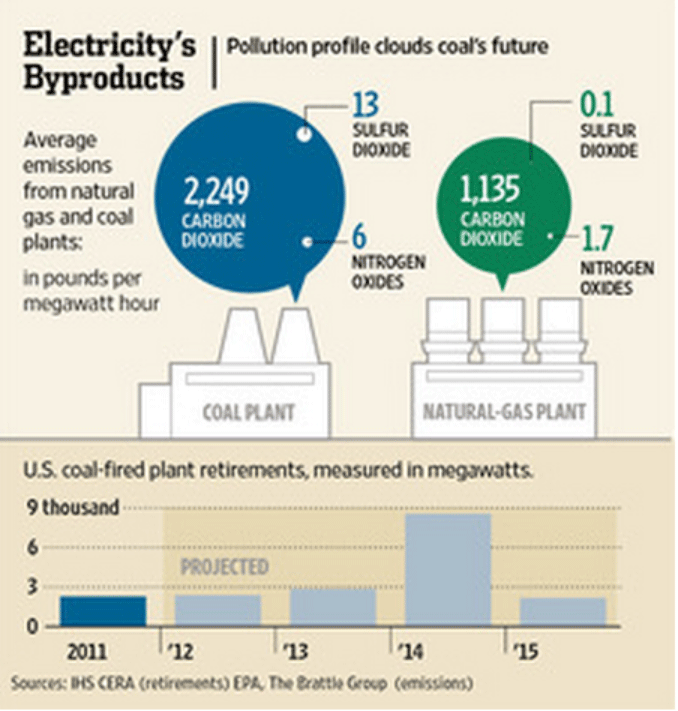
New regulations from the Environmental Protection Agency, together with potent competition from natural gas, are putting pressure on coal plants in the United States, according to The Wall Street Journal. From a global perspective, the low natural gas price that prevails in the United States is something of an anomaly, so the significance of this development should not be overstated. The relative emissions produced, respectively, by coal and natural gas must include consideration of the full cycle of production and consumption, and it is not clear whether the  attached graphic from the Journal does so. From the Journal:

For decades, coal produced more electricity than all other fuels combined, and as recently as 2003 accounted for almost 51% of net electricity generation, according to the U.S. Energy Information Administration.

But its share has dropped sharply in the last couple of years. It fell to 43% for the first nine months of 2011, as natural gas's share has jumped to almost 25% from under 17% in 2003. Meanwhile, gas prices, on average, have fallen 37 cents to $4.02 per million British thermal units so far this year.

Many big utilities have announced retirements of coal-burning power plants, including Southern Co., Progress Energy Inc., First Energy Corp., Xcel Energy Inc., Ameren Corp. and the Tennessee Valley Authority.

Coal consumption by the power sector is expected to fall 2% this year and 4% next year; even small movements are important because utilities burned 92.4% of the 1,071 million short tons of coal distributed last year in the U.S.

American Electric Power Co., the biggest user of coal in the U.S., expects to burn 67 million tons of coal this year but anticipates its consumption will drop to 50 million tons after it retires 25 coal-burning generating units in six states by 2015.

Experts think 10% to 20% of U.S. coal-fired generating capacity will get shut down by 2016.

Some of the soon-to-be-defunct plants have been operating only sporadically because they are old, inefficient and expensive to operate; Duke Energy Corp.'s Beckjord plant in Ohio, for example, didn't even run three of its six generating units in 2010.

Market and regulatory forces are "sounding a death knell for many an older coal-fired power plant," says Hugh Wynne, senior research analyst for Sanford C. Bernstein & Co. in New York.

John Stowell, vice president of energy and environmental policy atCharlotte, N.C.-based Duke, says the EPA rules are triggering "an aging baby-boomer-type situation," that will force a record number of retirements —and soon.

The coal and mining industries have opposed the new EPA regulations as job-killers, though some coal companies have job openings they can't fill. The communities that are home to the closing plants will lose jobs and tax revenues.

Closing Beckjord, for example, will eliminate as many as 120 jobs at the plant, according to Duke. The loss of tax revenues will cost the local school district in New Richmond, Ohio, about $2 million a year, says Teresa Napier, the district's chief financial officer. People are sorry to see the jobs go, but they understand why it is happening, she says, because "people want clean air."

Meanwhile, natural-gas plants are springing up around the country, from Connecticut to California. More are expected to crop up along natural-gas pipelines, especially in places like Texas where demand for power is outstripping supplies.

Duke, for example, is building four big power plants. Two, in the Carolinas, will burn natural gas. One, in Indiana, will convert coal to a cleaner, combustible gas. Only one, in North Carolina, will burn coal.

Cost is a big reason for the shift away from coal. Coal prices have jumped an average of 6.7% a year for the past decade, according to the U.S. Energy Information Administration. Coal cost $12 to $75 per short ton in early December, depending on where it was mined and how hot it burns.

And with energy markets flooded with cheap natural gas from shale rock, utilities have been idling coal capacity and running gas-fired plants harder. Fitch Credit Ratings estimates this is whittling coal sales by 63 million tons a year, equivalent to 6% of 2010 U.S. coal consumption. Fitch says the new EPA regulations could reduce coal sales by another 55 million tons a year, or 5% by 2016, due to plant retirements. Hardest hit: central Appalachian coal, due to its emissions profile.

Coal-firm shares have shown the strain. Peabody Energy Corp.'s stock has dropped by half since April, to $34.54 from a 52-week high of $73.95 set that month, and Consol Energy Inc.'s stock is off by a third since March to $38.38 from a 52-week high of $56.32 set that month.

But the new EPA rules are also significant. On Wednesday, the agency released its latest rule, requiring power plants to slash emissions of mercury, arsenic and other toxic pollutants within three to four years.

Last July, the agency released its final Cross-State Air Pollution Rule, which requires reductions of sulfur-dioxide and nitrogen-oxide emissions in 23 Eastern and Midwestern states beginning next year, as well as seasonal ozone reductions in 28 states.

The EPA also is working on rules to limit the amount of water drawn from natural waterways by power plants for cooling purposes and to control the handling and storage of coal waste. Many state utility commissioners say they fear the agency's recent rules will push up electricity prices or could even hurt electric-system reliability if too many power plants are shut down.

Stan Wise, an elected utility commissioner in Georgia, says "implementation of the rules has got us in a tizzy." He has written the EPA to express his objections.

EPA Administrator Lisa Jackson said the new mercury and toxics rule will deliver $37 billion to $90 billion in health benefits, per year, when fully implemented after 2016. "These are not abstract statistics or numbers," she said on Wednesday, but mean better health for millions of Americans. . . .

Rebecca Smith, "The Coal Age is Nearer to Its End," Wall Street Journal, December 23, 2011